














Rare Old Napoleonic-Era Manuscript Map of France by Bowen, 1810: Provincial boundaries, Paris, Lyon, Marseille, Bordeaux
Restored in our London workshop from the original 1810 map and printed to museum-grade archival standards. Full description
The Collector’s Offer
Choose two eligible works and receive 20% off both. Choose three and the lowest-priced one is complimentary, a maximum saving of 33%.
Mix and match eligible standard maps and fine-art prints. No code is required; the offer is applied automatically at checkout.
Standard made-to-order configurations are included. Bespoke sizes, personalised designs and commissioned work are excluded.
Need delivery to different addresses? Contact us before ordering.The Collector’s Offer
Choose two eligible works and receive 20% off both. Choose three and the lowest-priced one is complimentary, a maximum saving of 33%.
Mix and match eligible standard maps and fine-art prints. No code is required; the offer is applied automatically at checkout.
Standard made-to-order configurations are included. Bespoke sizes, personalised designs and commissioned work are excluded.
Need delivery to different addresses? Contact us before ordering. Restored in London • Printed and framed in the EU

Restored from the original 1810 map and printed to museum-grade archival standards. Full description
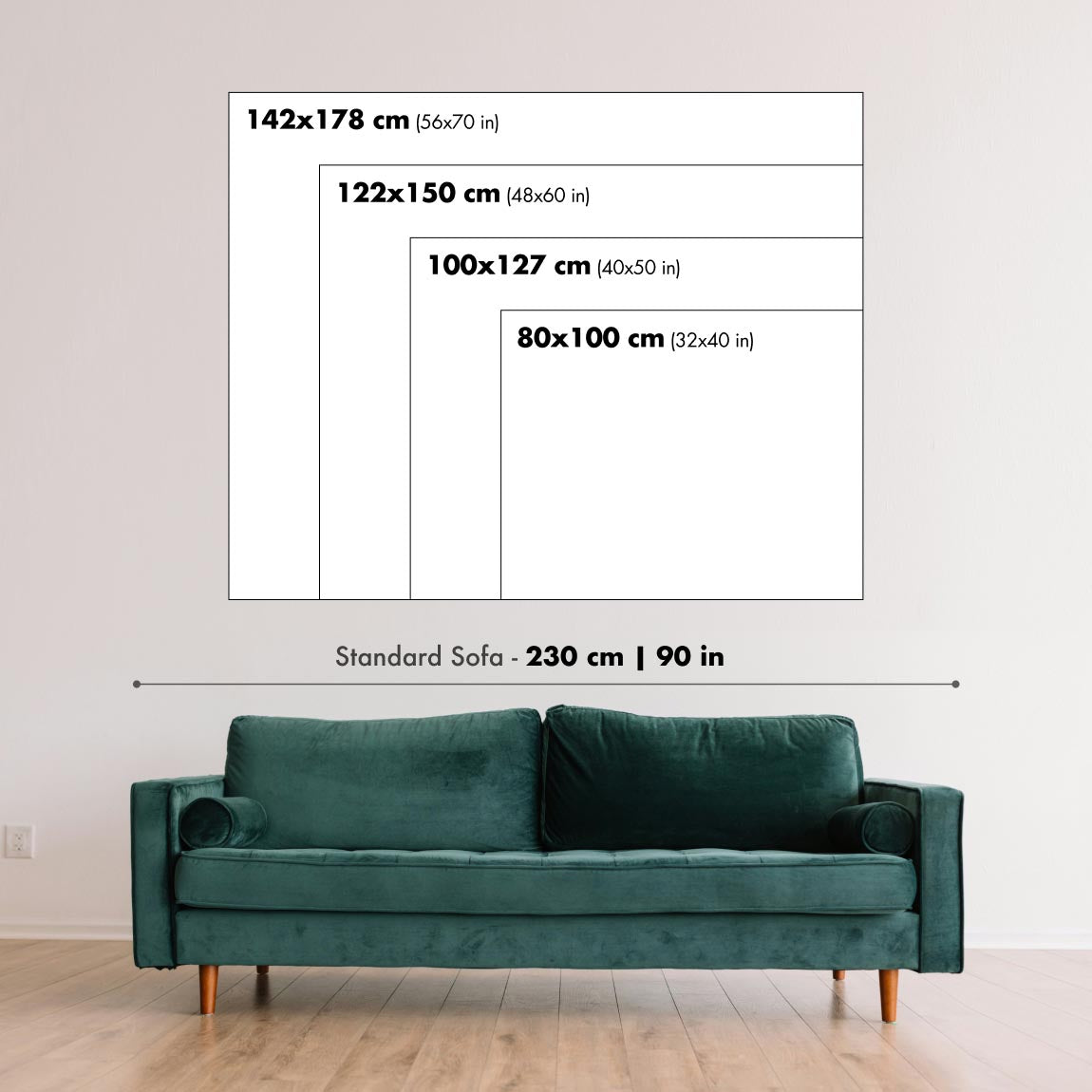
Choose your size
Choose your finish


(More info)
Gift message & custom finish

If you want to add a gift message, or a finish (jigsaw, aluminium board, etc.) that is not available here, please request it in the "order note" when you check out.
Every order is custom made, so if you need the size adjusted slightly, or printed on an unusual material, just let us know. We've done thousands of custom orders over the years, so there's (almost) nothing we can't manage.
You can also contact us before you order, if you prefer!
Own a piece of history
8,000+ five-star reviews


France divided into provinces is an evocative 1810 manuscript map by Frances Bowen that guides the viewer through France’s historic regional mosaic...
Continue readingFrance divided into provinces is an evocative 1810 manuscript map by Frances Bowen that guides the viewer through France’s historic regional mosaic just as the Napoleonic era was refashioning political space. Rendered in pen and ink with watercolor, the composition bears the intimate clarity of a school atlas: succinct, legible, and ordered for learning. Bowen’s hand emphasizes boundaries and names over ornament, inviting close reading of provinces whose contours long predate the Revolution. The effect is at once scholarly and lyrical—color-washed borders gather the eye while crisp inscriptions restore a geography of memory, offering an elegant counterpoint to the more standardized departmental outlines that dominated official cartography of the period.
Bowen’s decision to foreground provinces in 1810 is telling. Two decades after 1790’s sweeping reorganization into departments, France’s historical regions—Brittany, Normandy, Burgundy, Champagne, Île-de-France, Languedoc, Provence, Dauphiné, Alsace, and others—remained essential to understanding language, law, trade, and custom. By charting these older divisions, the map becomes a lesson in continuity amid change, a guide to the cultural scaffolding beneath a centralized state. Each province is clearly bounded and named, its identity restored through careful wash tints and incisive pen lines, creating a didactic yet contemplative portrait of a nation whose administrative present rested upon a richly variegated past.
Cities and towns appear as anchors within this older framework, situating urban power in regional context. Paris stands at the heart of Île-de-France, emblem of central authority yet historically tethered to its ring of provinces. Maritime Marseille and Bordeaux command opposing coasts, gateways for Mediterranean and Atlantic exchange. Lyon, poised between Burgundy and the Rhône valley, affirms the historic centrality of transalpine commerce and silk. Toulouse and Montpellier articulate the Languedoc plain; Strasbourg marks the Rhine frontier and Alsatian distinctiveness; Nantes looks seaward from Brittany; Lille signals the industrious north; and Nice, on the sunlit Mediterranean littoral, gestures to centuries of cross-border influence.
Though primarily political in its emphasis, the map leaves room for the land itself to speak. Labels for surrounding waters—most prominently the Mediterranean Sea—frame the peninsula-like thrust of Provence and the south. River systems, suggested through the placement of major towns and the flow of toponyms, hint at the Loire’s broad sweep, the Seine’s sinuous arc, the Rhône’s descent from alpine source to sea, and the Garonne’s march to the Atlantic. Subtle references to mountain chains and valleys recall the Alps, Pyrenees, and the rugged heart of the Massif Central, reinforcing how terrain once shaped provincial borders and the rhythms of travel, trade, and defense.
As an educator-cartographer, Frances Bowen channels the early nineteenth century’s ambition to organize political knowledge and democratize geography. Her intricate pen work and lucid color hierarchy embody the pedagogical clarity prized in school atlases, while her historical lens acknowledges that maps are arguments as much as images. In tracing provinces at the very moment departments reigned, Bowen captures a transitional cartographic consciousness: one eye on reform, the other on inheritance. The result is a map that rewards both study and admiration—an artifact where precise draftsmanship, historical insight, and cultural memory converge to illuminate France’s enduring regional soul.
Cities and towns on this map
- Paris
- Marseille
- Lyon
- Toulouse
- Nice
- Nantes
- Strasbourg
- Montpellier
- Bordeaux
- Lille
Notable Features & Landmarks
- Provincial Boundaries: Clearly defined separations of various historical provinces.
- Geographical Labels: Names of provinces and notable regions are inscribed throughout the map.
- Surrounding Bodies of Water: Includes labels for the Mediterranean Sea and various other smaller bodies of water.
- Landmarks: Some geographical references such as mountains and valleys may be depicted, although not directly observable in the image provided.
Historical and design context
- Title: France divided into provinces.
- Mapmaker: Frances Bowen.
- Year Created: 1810.
- Style and Medium: Pen and ink with watercolor, in a hand-made style typical of school atlases rather than commercial printed maps.
- Educational Purpose: Part of the early nineteenth-century effort to educate the public on geography and organize political knowledge.
- Thematic Focus: Illustrates historical regional divisions of France, emphasizing internal structure and regional identities influencing administration and culture.
- Historical Significance: Reflects shifting understandings and representations of geography shaped by political and cultural changes of the era.
- Visual Characteristics: Intricate pen work and color used to delineate provincial boundaries, highlighting detailed cartographic representation.
Please double check the images to make sure that a specific town or place is shown on this map. You can also get in touch and ask us to check the map for you.
This map looks great at every size, but I always recommend going for a larger size if you have space. That way you can easily make out all of the details.
This map looks amazing at sizes all the way up to 50in (125cm). If you are looking for a larger map, please get in touch.
The model in the listing images is holding the 16x16in (40x40cm) version of this map.
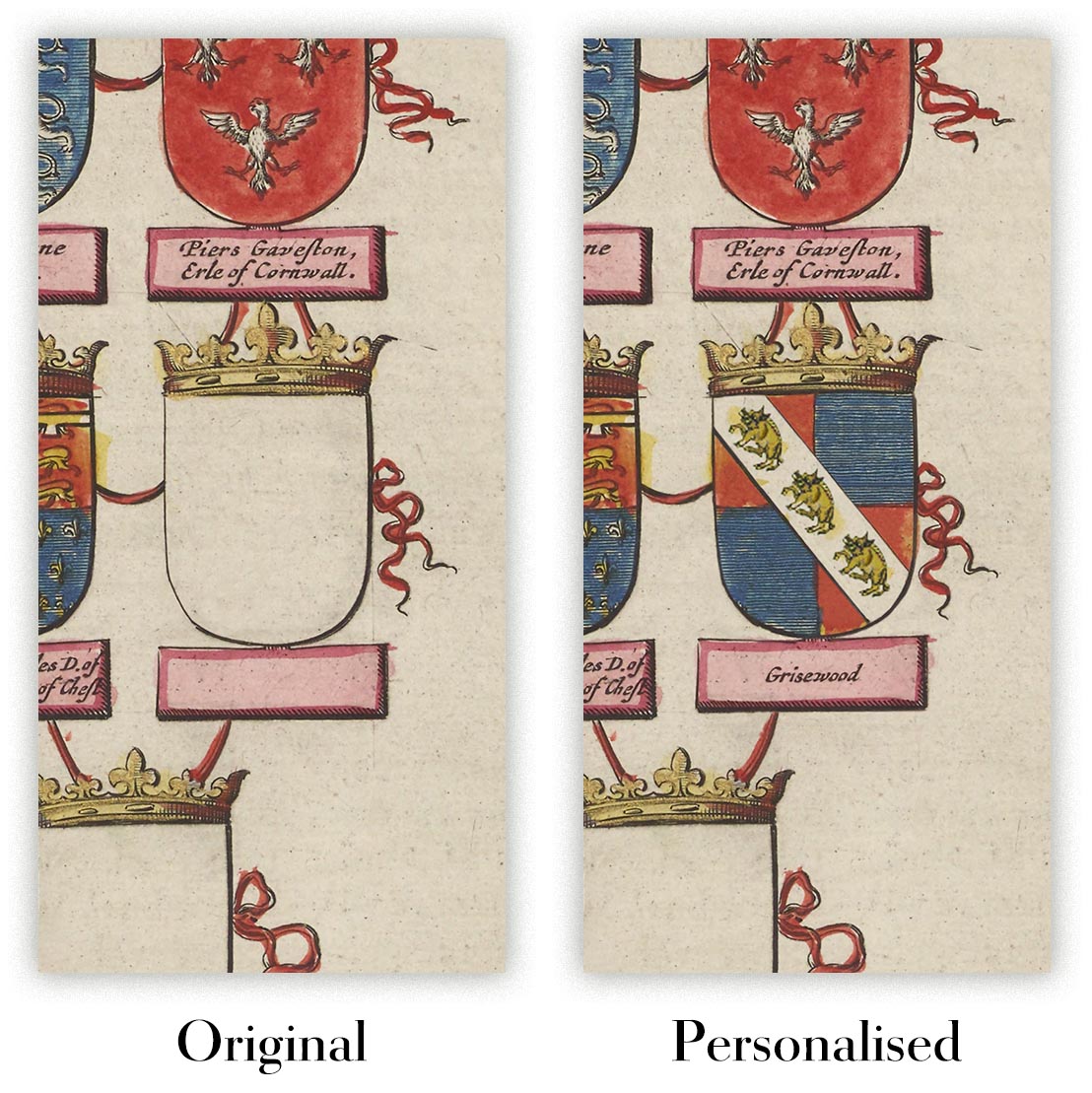
The fifth listing image shows an example of my map personalisation service.
If you’re looking for something slightly different, check out my collection of the best old maps to see if something else catches your eye.
Please contact me to check if a certain location, landmark or feature is shown on this map.
This would make a wonderful birthday, Christmas, Father's Day, work leaving, anniversary or housewarming gift for someone from the areas covered by this map.
This map is available as a giclée print on acid free archival matte paper, or you can buy it framed. The frame is a nice, simple black frame that suits most aesthetics. Please get in touch if you'd like a different frame colour or material. My frames are glazed with super-clear museum-grade acrylic (perspex/acrylite), which is significantly less reflective than glass, safer, and will always arrive in perfect condition.
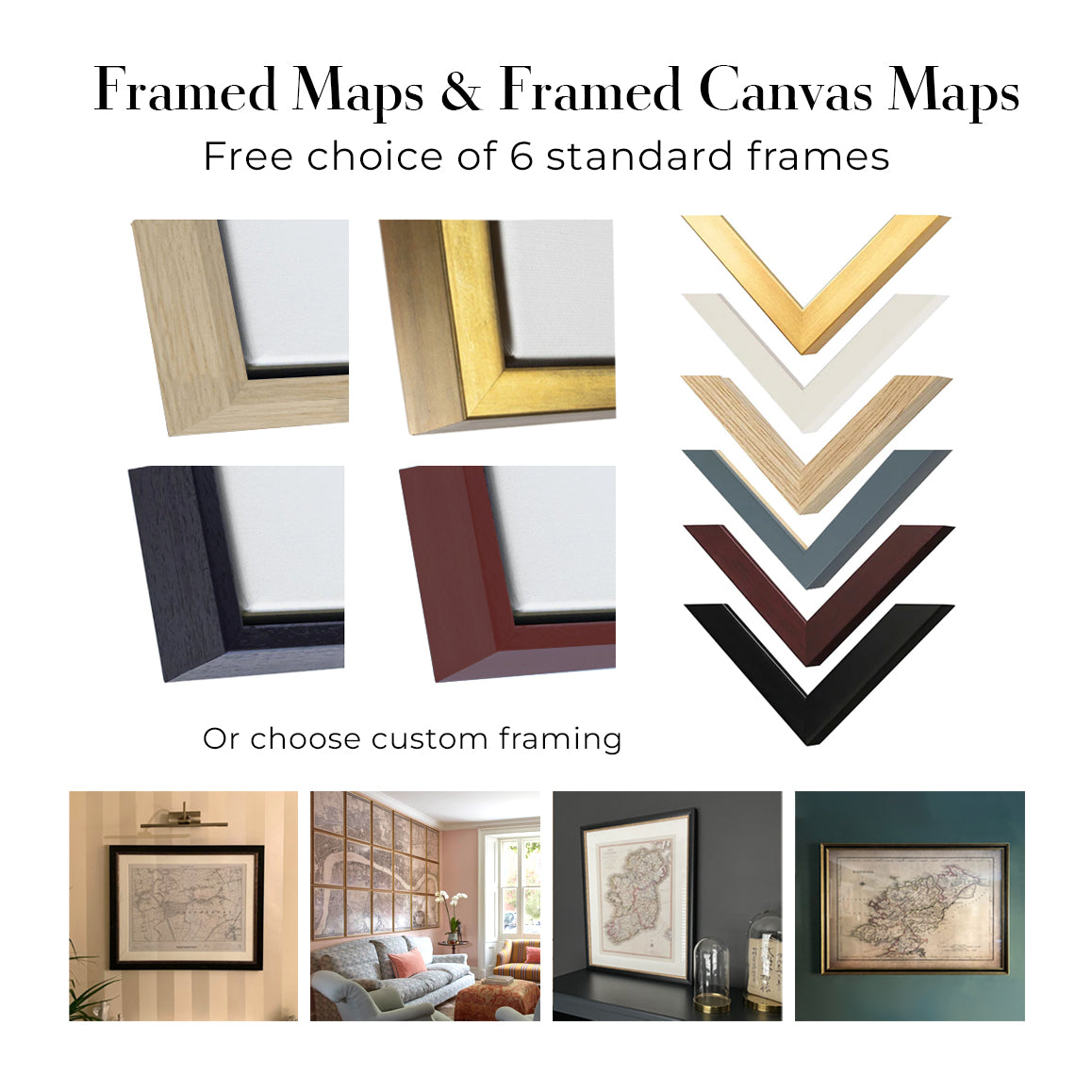
This map is also available as a float framed canvas, sometimes known as a shadow gap framed canvas or canvas floater. The map is printed on artist's cotton canvas and then stretched over a handmade box frame. We then "float" the canvas inside a wooden frame, which is available in a range of colours (black, dark brown, oak, antique gold and white). This is a wonderful way to present a map without glazing in front. See some examples of float framed canvas maps and explore the differences between my different finishes.
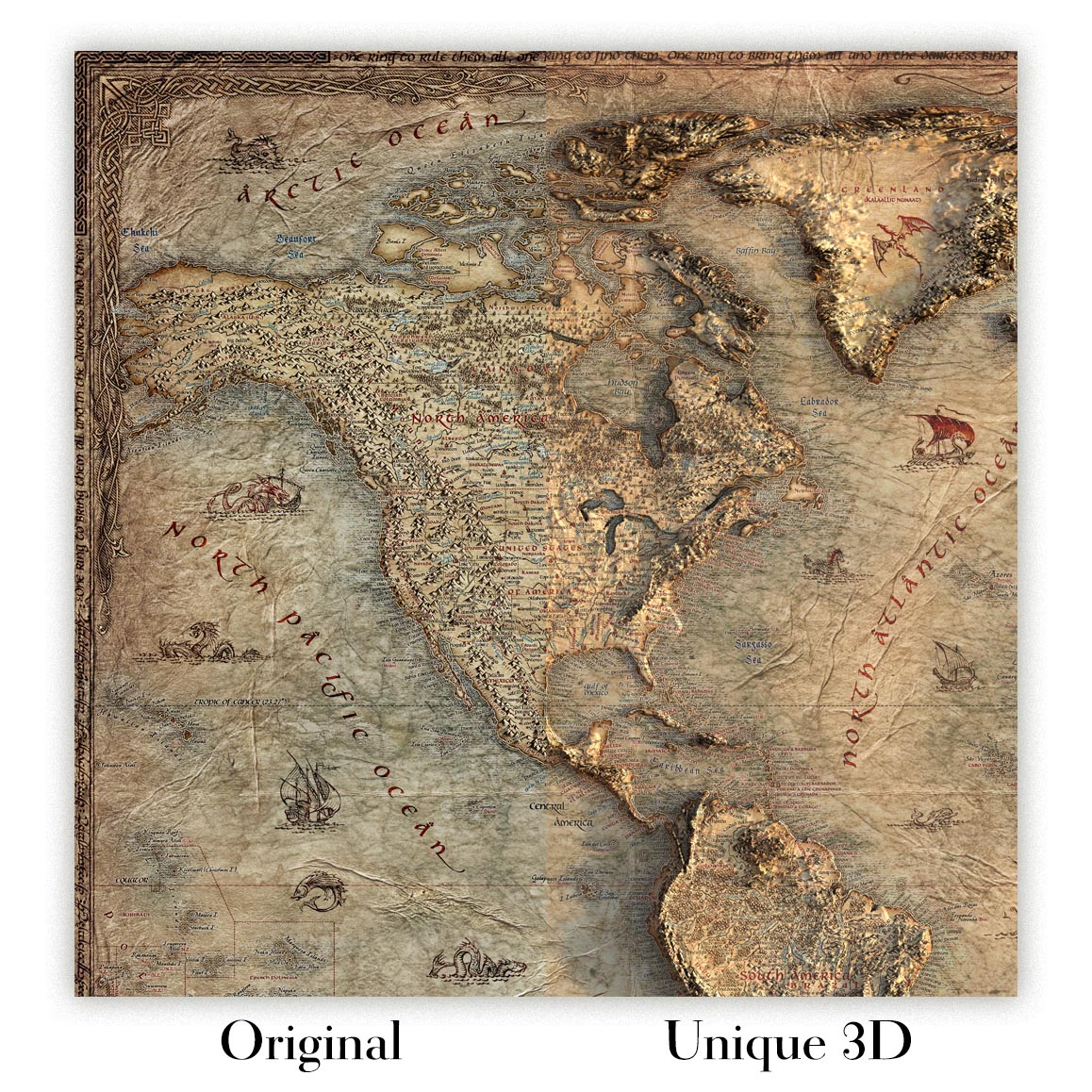
For something truly unique, this map is also available in "Unique 3D", our trademarked process that dramatically transforms the map so that it has a wonderful sense of depth. We combine the original map with detailed topography and elevation data, so that mountains and the terrain really "pop". For more info and examples of 3D maps, check my Unique 3D page.
France divided into provinces is an evocative 1810 manuscript map by Frances Bowen that guides the viewer through France’s historic regional mosaic just as the Napoleonic era was refashioning political space. Rendered in pen and ink with watercolor, the composition bears the intimate clarity of a school atlas: succinct, legible, and ordered for learning. Bowen’s hand emphasizes boundaries and names over ornament, inviting close reading of provinces whose contours long predate the Revolution. The effect is at once scholarly and lyrical—color-washed borders gather the eye while crisp inscriptions restore a geography of memory, offering an elegant counterpoint to the more standardized departmental outlines that dominated official cartography of the period.
Bowen’s decision to foreground provinces in 1810 is telling. Two decades after 1790’s sweeping reorganization into departments, France’s historical regions—Brittany, Normandy, Burgundy, Champagne, Île-de-France, Languedoc, Provence, Dauphiné, Alsace, and others—remained essential to understanding language, law, trade, and custom. By charting these older divisions, the map becomes a lesson in continuity amid change, a guide to the cultural scaffolding beneath a centralized state. Each province is clearly bounded and named, its identity restored through careful wash tints and incisive pen lines, creating a didactic yet contemplative portrait of a nation whose administrative present rested upon a richly variegated past.
Cities and towns appear as anchors within this older framework, situating urban power in regional context. Paris stands at the heart of Île-de-France, emblem of central authority yet historically tethered to its ring of provinces. Maritime Marseille and Bordeaux command opposing coasts, gateways for Mediterranean and Atlantic exchange. Lyon, poised between Burgundy and the Rhône valley, affirms the historic centrality of transalpine commerce and silk. Toulouse and Montpellier articulate the Languedoc plain; Strasbourg marks the Rhine frontier and Alsatian distinctiveness; Nantes looks seaward from Brittany; Lille signals the industrious north; and Nice, on the sunlit Mediterranean littoral, gestures to centuries of cross-border influence.
Though primarily political in its emphasis, the map leaves room for the land itself to speak. Labels for surrounding waters—most prominently the Mediterranean Sea—frame the peninsula-like thrust of Provence and the south. River systems, suggested through the placement of major towns and the flow of toponyms, hint at the Loire’s broad sweep, the Seine’s sinuous arc, the Rhône’s descent from alpine source to sea, and the Garonne’s march to the Atlantic. Subtle references to mountain chains and valleys recall the Alps, Pyrenees, and the rugged heart of the Massif Central, reinforcing how terrain once shaped provincial borders and the rhythms of travel, trade, and defense.
As an educator-cartographer, Frances Bowen channels the early nineteenth century’s ambition to organize political knowledge and democratize geography. Her intricate pen work and lucid color hierarchy embody the pedagogical clarity prized in school atlases, while her historical lens acknowledges that maps are arguments as much as images. In tracing provinces at the very moment departments reigned, Bowen captures a transitional cartographic consciousness: one eye on reform, the other on inheritance. The result is a map that rewards both study and admiration—an artifact where precise draftsmanship, historical insight, and cultural memory converge to illuminate France’s enduring regional soul.
Cities and towns on this map
- Paris
- Marseille
- Lyon
- Toulouse
- Nice
- Nantes
- Strasbourg
- Montpellier
- Bordeaux
- Lille
Notable Features & Landmarks
- Provincial Boundaries: Clearly defined separations of various historical provinces.
- Geographical Labels: Names of provinces and notable regions are inscribed throughout the map.
- Surrounding Bodies of Water: Includes labels for the Mediterranean Sea and various other smaller bodies of water.
- Landmarks: Some geographical references such as mountains and valleys may be depicted, although not directly observable in the image provided.
Historical and design context
- Title: France divided into provinces.
- Mapmaker: Frances Bowen.
- Year Created: 1810.
- Style and Medium: Pen and ink with watercolor, in a hand-made style typical of school atlases rather than commercial printed maps.
- Educational Purpose: Part of the early nineteenth-century effort to educate the public on geography and organize political knowledge.
- Thematic Focus: Illustrates historical regional divisions of France, emphasizing internal structure and regional identities influencing administration and culture.
- Historical Significance: Reflects shifting understandings and representations of geography shaped by political and cultural changes of the era.
- Visual Characteristics: Intricate pen work and color used to delineate provincial boundaries, highlighting detailed cartographic representation.
Please double check the images to make sure that a specific town or place is shown on this map. You can also get in touch and ask us to check the map for you.
This map looks great at every size, but I always recommend going for a larger size if you have space. That way you can easily make out all of the details.
This map looks amazing at sizes all the way up to 50in (125cm). If you are looking for a larger map, please get in touch.
The model in the listing images is holding the 16x16in (40x40cm) version of this map.
The fifth listing image shows an example of my map personalisation service.
If you’re looking for something slightly different, check out my collection of the best old maps to see if something else catches your eye.
Please contact me to check if a certain location, landmark or feature is shown on this map.
This would make a wonderful birthday, Christmas, Father's Day, work leaving, anniversary or housewarming gift for someone from the areas covered by this map.
This map is available as a giclée print on acid free archival matte paper, or you can buy it framed. The frame is a nice, simple black frame that suits most aesthetics. Please get in touch if you'd like a different frame colour or material. My frames are glazed with super-clear museum-grade acrylic (perspex/acrylite), which is significantly less reflective than glass, safer, and will always arrive in perfect condition.
This map is also available as a float framed canvas, sometimes known as a shadow gap framed canvas or canvas floater. The map is printed on artist's cotton canvas and then stretched over a handmade box frame. We then "float" the canvas inside a wooden frame, which is available in a range of colours (black, dark brown, oak, antique gold and white). This is a wonderful way to present a map without glazing in front. See some examples of float framed canvas maps and explore the differences between my different finishes.
For something truly unique, this map is also available in "Unique 3D", our trademarked process that dramatically transforms the map so that it has a wonderful sense of depth. We combine the original map with detailed topography and elevation data, so that mountains and the terrain really "pop". For more info and examples of 3D maps, check my Unique 3D page.
Many of our maps and art prints are chosen as thoughtful gifts for homes, offices, studies and meaningful places.
Choose a framed option for the easiest ready-to-hang gift, or choose an unframed print if the recipient may prefer to select their own frame.
We make orders locally in 24 countries around the world, so gifts can often be produced close to the recipient. This helps them arrive faster, travel more safely, and avoid customs or import duty surprises.
- We can deliver directly to the recipient
- Framed pieces arrive ready to hang
- Unframed prints are carefully packed in a strong protective tube
- Almost every order is made locally, for faster, safer gifting
- 90-day returns give the recipient time to decide
If you are not sure what to choose, please contact us. We can help you pick the right map, size, finish or delivery option.
Most orders are made locally and delivered in around 2–3 working days, depending on the product, size and destination.
We print and frame maps and artwork in 24 countries around the world, so your order is usually made close to you or your recipient. That means faster delivery, less time in transit, and no customs or import duty surprises.
Personalised and customised pieces usually take an extra 1–2 working days, because we prepare your design and send it to you for approval before printing.
Very large framed orders can take a little longer, as they need extra care in production and delivery.
Every order is carefully packaged: unframed prints are sent in a strong protective tube, while framed pieces are securely packed with protective materials around the frame.
If you need your order by a particular date, please contact us before ordering. We’ll check the best production route and delivery option for your location.
Express delivery is available at checkout for most countries. Next-day delivery is available in the UK, US, Singapore and the UAE.
Your order is covered by our 90-day returns policy and 10-year guarantee.
Our standard frame is a gallery-style black ash hardwood frame, with a simple, modern look. It is approximately 20mm (0.8in) wide. You can also view some lovely customer photos of framed maps and art.
We use super-clear acrylic glazing, also known as Perspex or Acrylite, instead of traditional glass. It is lighter, safer, and has lower reflectivity, giving the artwork a clearer, cleaner appearance.
Six standard frame colours are available at no extra cost: black, dark brown, dark grey, oak, white, and antique gold. Custom framing and mounting/matting is also available for customers looking for something more specific.
Most maps, art prints, and illustrations are also available as a framed canvas. We use matte cotton canvas, stretch it over a sustainably sourced wooden box frame, and then float the piece within a wooden outer frame. The finished result is beautifully presented, with no glazing between you and the artwork.
All frames are supplied ready to hang, with either string or brackets fitted to the back. Very large frames will include heavy-duty hanging plates and/or a mounting baton. If you have any questions, please get in touch.
We can also supply old maps and artwork on canvas, foam board, cotton rag, and other materials.
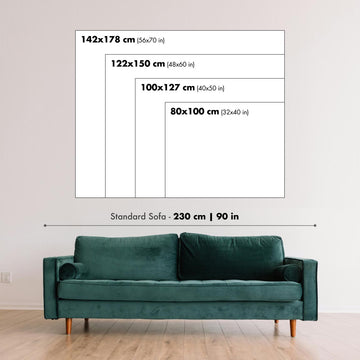
If you would prefer to frame your map or artwork yourself, please read our size guide before ordering.
We work with interior designers, hospitality businesses, property professionals, offices and corporate buyers on individual pieces and larger coordinated projects.
This map can be adapted for a particular wall, room or project, and our workshop can help coordinate the dimensions, material and framing before production.
- Exact, oversized and made-to-measure dimensions
- Custom framing, mounting and alternative materials
- Coordinated pieces for several rooms or locations
- Map personalisation, to mark important locations or add extra details
- Map and framing guidance from our workshop
- Local production for projects around the world
Every Unique Maps piece begins with an authentic cartographic source or an original design from our London studio.
For our historic maps, we source rare originals from libraries, archives, auction houses and private collections around the world. We carefully restore each map for print—repairing age-related damage, balancing colour and improving clarity while preserving its original detail, texture and character.
Once restored, the map is prepared for your chosen size and finish. Your piece is then printed and, where selected, framed close to its delivery destination.
Our map prints use acid-free 200gsm archival matte paper and fade-resistant pigment inks, creating a rich, non-glossy finish designed to last. Framed maps use crystal-clear optical acrylic and arrive ready to hang.
Canvas, cotton-rag and other specialist presentations are also available. Learn more about our materials and finishes.
Personalising your map
You can add a short title or dedication, mark one meaningful place, or request one considered visual detail. For personalised designs, we send a proof before printing and you can request changes before approval.
For more complex bespoke commissions, contact our design team.
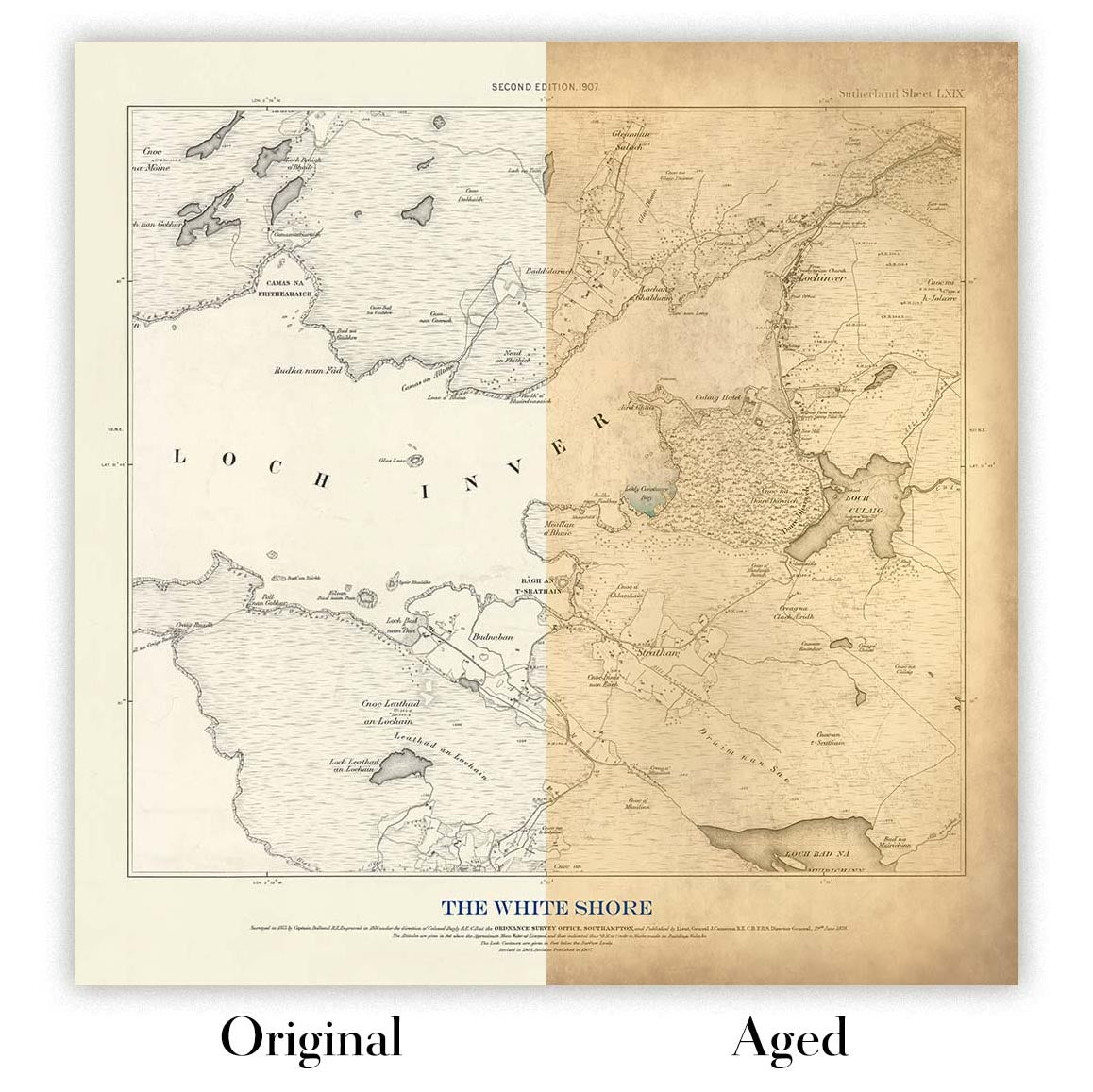
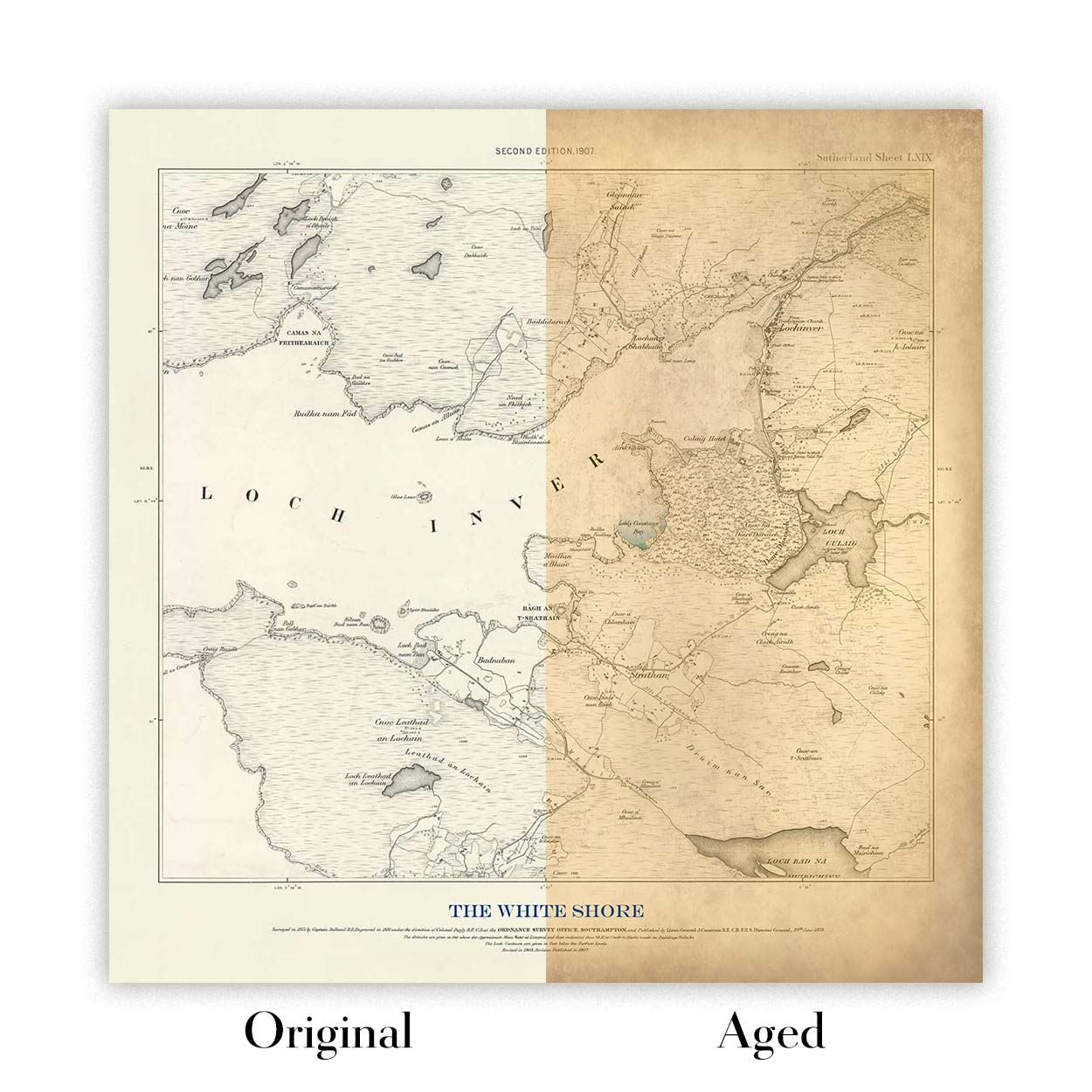
Original or Aged
Choose Original for true-to-source colour, or Aged for a warmer, richer antique character created with our specialist ageing process. See examples of our Aged maps.
We’ve been restoring and producing maps and art prints since 1984, and we stand behind every piece.
Every order is covered by our 10-year guarantee and damage-free delivery guarantee. If your piece arrives damaged, we’ll replace or remake it free of charge. If anything else isn’t right, contact our workshop team and we’ll put it right promptly.
See our returns and refund policy for full details.
Or try searching for something!


