














Large Old Map of Lewis & Clark in the Western U.S. 1814: Missouri & Columbia R, Rocky Mtns, St. Louis, Portland
Restaurata nel nostro laboratorio di Londra dalla mappa originale del 1814 e stampata in qualità museale. Descrizione completa
L’offerta del Collezionista
Scegli due opere idonee e ricevi il 20% di sconto su entrambe. Scegline tre e quella al prezzo più basso è in omaggio, con un risparmio massimo del 33%.
Abbina liberamente mappe standard idonee e stampe d’arte fine art. Non è richiesto alcun codice; l’offerta viene applicata automaticamente al checkout.
Sono incluse le configurazioni standard su ordinazione. Sono esclusi formati su misura, design personalizzati e lavori su commissione.
Hai bisogno di consegne a indirizzi diversi? Contattaci prima di effettuare l’ordine.L’offerta del Collezionista
Scegli due opere idonee e ricevi il 20% di sconto su entrambe. Scegline tre e quella al prezzo più basso è in omaggio, con un risparmio massimo del 33%.
Abbina liberamente mappe standard idonee e stampe d’arte fine art. Non è richiesto alcun codice; l’offerta viene applicata automaticamente al checkout.
Sono incluse le configurazioni standard su ordinazione. Sono esclusi formati su misura, design personalizzati e lavori su commissione.
Hai bisogno di consegne a indirizzi diversi? Contattaci prima di effettuare l’ordine. Restaurato a Londra • Stampato e incorniciato nell’UE

Restaurata dalla mappa originale del 1814 e stampata in qualità museale. Descrizione completa
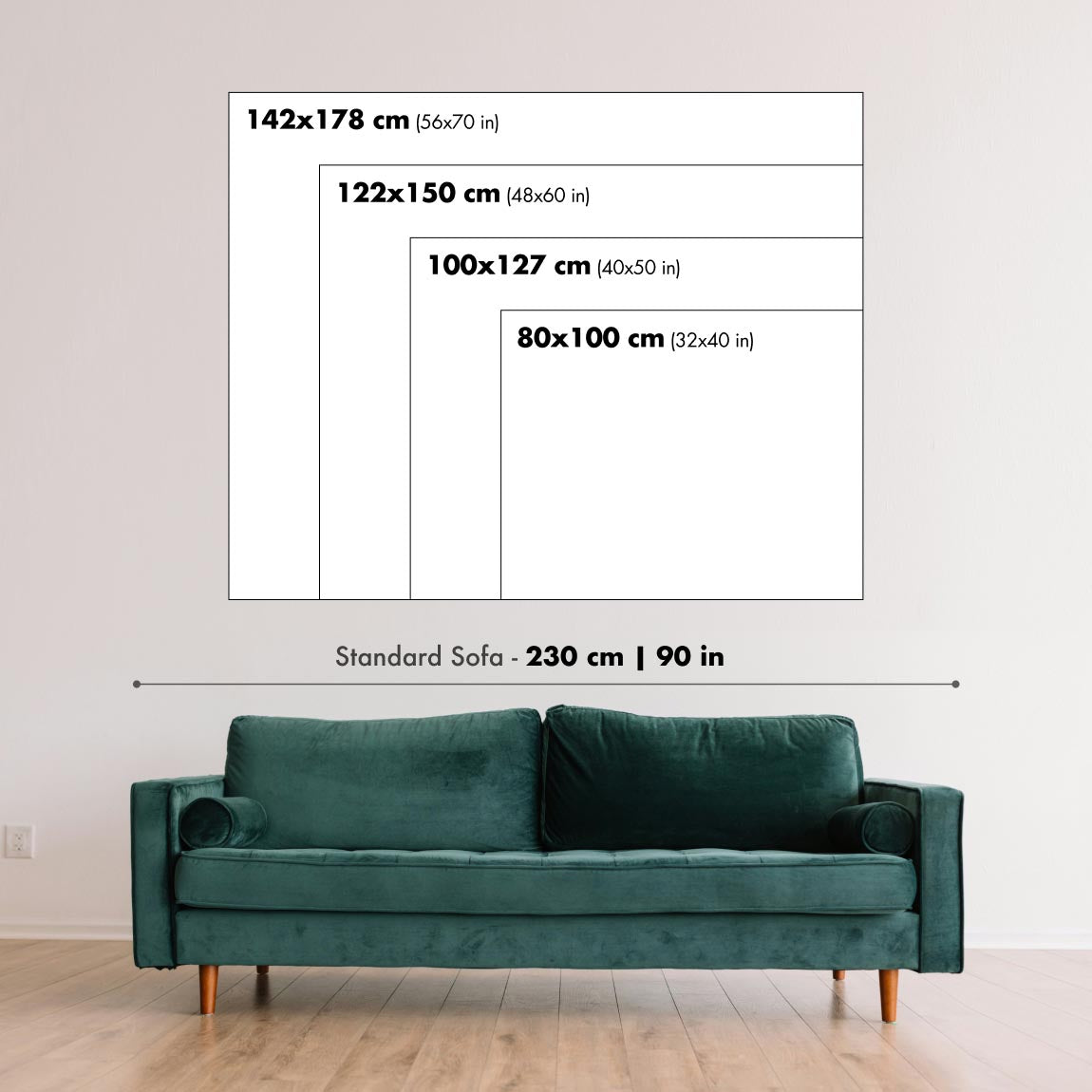
Scegli il formato
Scegli la finitura


(Maggiori informazioni)
Gift message & custom finish

If you want to add a gift message, or a finish (jigsaw, aluminium board, etc.) that is not available here, please request it in the "order note" when you check out.
Every order is custom made, so if you need the size adjusted slightly, or printed on an unusual material, just let us know. We've done thousands of custom orders over the years, so there's (almost) nothing we can't manage.
You can also contact us before you order, if you prefer!
Porta a casa un pezzo di storia
Oltre 8.000 recensioni a 5 stelle


A Map of Lewis and Clark's Track Across the Western Portion of North America, from the Mississippi to the Pacific Ocean is...
Continua a leggereA Map of Lewis and Clark's Track Across the Western Portion of North America, from the Mississippi to the Pacific Ocean is William Clark’s epochal cartographic summation of the Corps of Discovery, published in 1814. Widely regarded as the most significant printed map of the American West, it compresses an eight-thousand-mile odyssey (1804–1806) into a coherent geography that Americans could finally grasp. Here the sinuous Missouri and the ocean-bound Columbia are set in convincing relation to the Rocky Mountains, sweeping aside generations of conjecture. The map is the first tangible cartographic expression of Thomas Jefferson’s vision of continental reach—an early, formative articulation of Manifest Destiny rendered in the meticulous copperplate idiom of its day, where every river bend, mountain hachure, and annotation serves both science and statecraft.
From the Mississippi’s gateway at St. Louis, Clark’s engraved track ascends the Missouri, threading the tallgrass corridor that would later cradle cities like Kansas City. The river’s great meanders are fixed against prairies studded with Indian settlements and trading grounds, culminating in the cosmopolitan Mandan-Hidatsa villages that anchored winter quarters. Westward, the Missouri fractures into drama: the thunderous Great Falls, the austere White Cliffs, and the revelatory Three Forks, where Clark inscribes the Jefferson, Madison, and Gallatin—new names for new knowledge. True to the expedition’s priority, the sources of the Upper Missouri are treated with uncommon care, their braided courses and portages annotated to show how near, and yet how hard-won, the divide with the Pacific watershed would be.
Crossing the Continental Divide, the map records the lived landscape of the Shoshone, Nez Perce, and Salish homelands, translating guidance from Indigenous knowledge into routes across the Bitterroots and along high-country trails. The expedition’s westward descent is plotted onto “Lewis’s River” (the Snake), the Clearwater, and the Columbia—rivers that become both road and chronicle. The mid-Columbia’s narrows and cataracts are noted, as are the confluences that structure the Northwest: the “Multnomah” (Willamette) near present-day Portland, and the broad estuary where Chinookan villages lined the tidal flats of the lower Columbia. By the time Clark’s engraved track reaches the Pacific, the Northwest emerges not as rumor but as a network—navigable, mapped, and newly intelligible.
Clark was not merely a traveler but an exacting cartographer, distilling field sketches, celestial observations, and painstaking dead reckoning into a single, authoritative image. The map fuses firsthand surveying with knowledge shared by Indigenous leaders and hunters, preserving names, village sites, trails, and resource notes that make it as ethnographic as it is geographic. Early nineteenth-century engraving conventions—fine hachures for relief, elegant river engraving, and an economy of crisp labels—serve a deeply empirical program: to fix places in space and relation. Where earlier depictions trafficked in conjecture, Clark’s work substitutes measured itineraries, explicit portages, and descriptive inscriptions that teach the land as one reads the route.
The influence of the 1814 map radiated for decades. Traders, soldiers, naturalists, and emigrants alike mined its pages to cross the trans-Missouri West, long before railroad surveys and later government expeditions refined its detail. It set foundational principles for mapping the Northwest and the Upper Missouri regions, shaping American geographical consciousness and the practical pathways of overland transit. As the cartographic standard-bearer of the age of exploration, it anchors any collection of Western Americana—an artifact in which narrative, science, and national ambition entwine. In Clark’s engraved track, one sees a continent cohering: rivers converging, mountains yielding their crossings, and the American West resolving from blankness into legible form.
Cities and towns on this map
- St. Louis, Missouri (modern population: approx. 300,000)
- Portland, Oregon (modern population: approx. 650,000)
- Kansas City, Missouri (modern population: approx. 500,000)
Notable Features & Landmarks
- Rivers: Several major rivers, including the Missouri River and Columbia River
- Mountain ranges: Notable mountains such as the Rocky Mountains
- Landmarks: Points indicating Indian settlements and various natural landmarks
- Inscriptions: Descriptive labels for different geographical features, tribal areas, and routes
Historical and design context
- Name: A Map of Lewis and Clark's Track Across the Western Portion of North America, from the Mississippi to the Pacific Ocean
- Mapmaker and date: William Clark, published in 1814
- Created after the Louisiana Purchase to document the Lewis & Clark expedition (1804–1806) and its eight-thousand-mile journey
- Provided the first accurate depiction of key geographic relationships in the Northwest and Upper Missouri River regions
- Regarded as the most significant printed map of the West; cornerstone of Western Americana
- Reflects the first tangible step toward Thomas Jefferson’s vision of Manifest Destiny
- Vital in shaping American geographical knowledge and facilitating overland transit for decades
- Design/style: Intricate early-19th-century engraving with meticulous cartographic techniques
- Coverage focus: Northwestern United States, with special attention to the sources of the Upper Missouri River
- Themes: Exploration and discovery; Manifest Destiny; Indigenous interactions and cultural heritage representation
Please double check the images to make sure that a specific town or place is shown on this map. You can also get in touch and ask us to check the map for you.
This map looks great at every size, but I always recommend going for a larger size if you have space. That way you can easily make out all of the details.
This map looks amazing at sizes all the way up to 100in (250cm). If you are looking for a larger map, please get in touch.
Please note: the labels on this map are hard to read if you order a map that is 16in (40cm) or smaller. The map is still very attractive, but if you would like to read the map easily, please buy a larger size.
This map is wider than most maps, which would make it a perfect statement piece above a mantelpiece, sofa or desk.
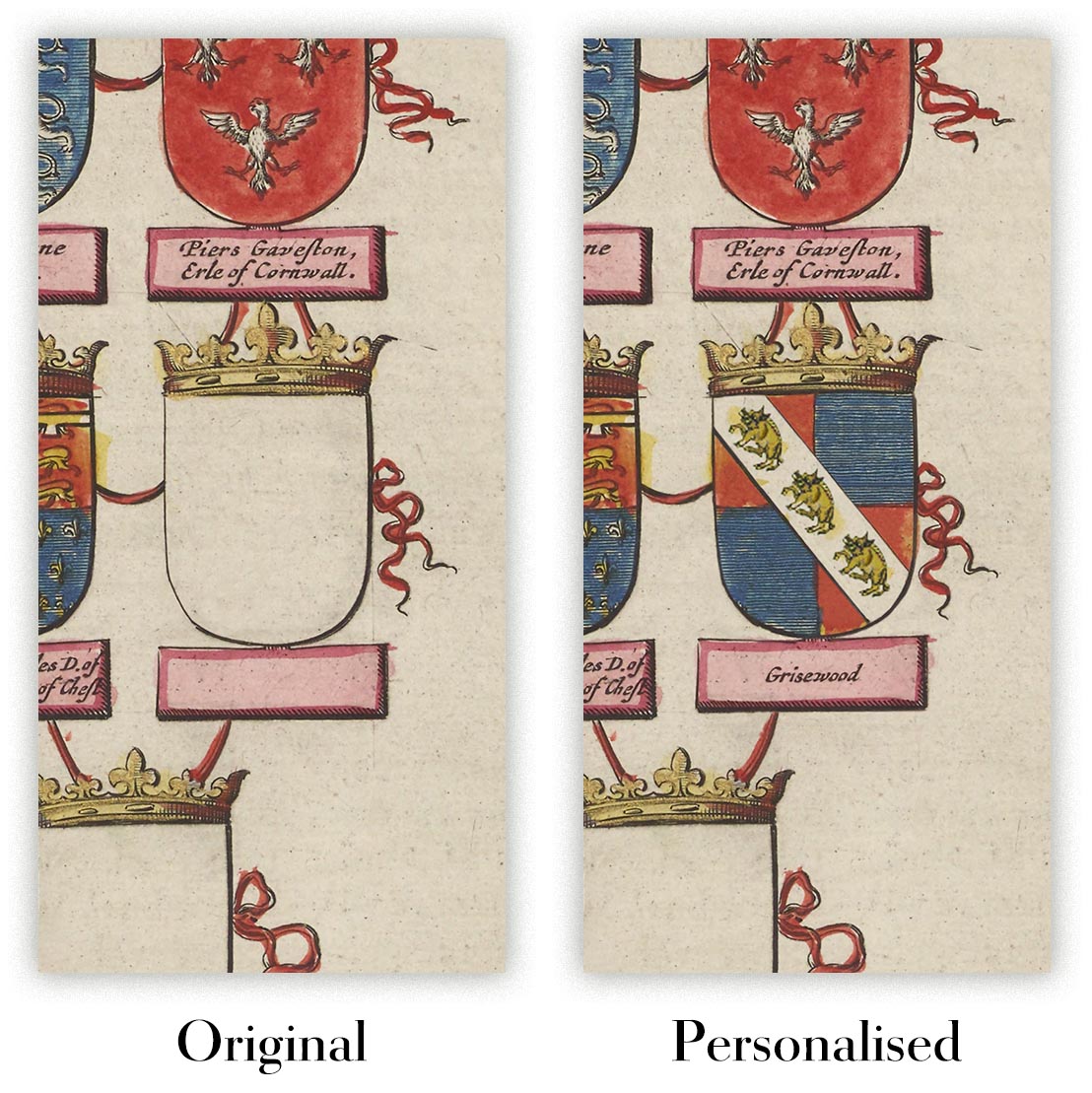
The fifth listing image shows an example of my map personalisation service.
If you’re looking for something slightly different, check out my collection of the best old maps to see if something else catches your eye.
Please contact me to check if a certain location, landmark or feature is shown on this map.
This would make a wonderful birthday, Christmas, Father's Day, work leaving, anniversary or housewarming gift for someone from the areas covered by this map.
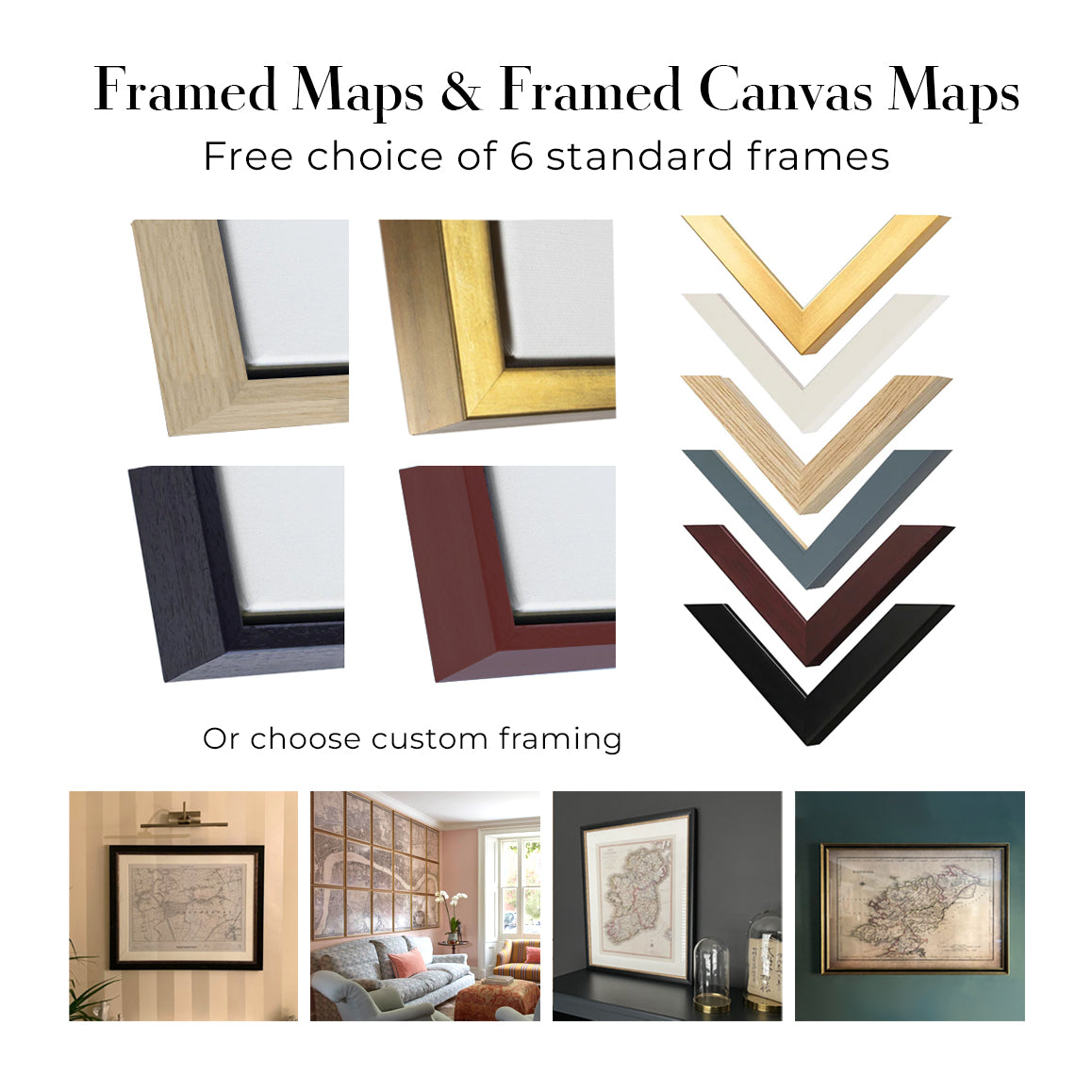
This map is available as a giclée print on acid free archival matte paper, or you can buy it framed. The frame is a nice, simple black frame that suits most aesthetics. Please get in touch if you'd like a different frame colour or material. My frames are glazed with super-clear museum-grade acrylic (perspex/acrylite), which is significantly less reflective than glass, safer, and will always arrive in perfect condition.
This map is also available as a float framed canvas, sometimes known as a shadow gap framed canvas or canvas floater. The map is printed on artist's cotton canvas and then stretched over a handmade box frame. We then "float" the canvas inside a wooden frame, which is available in a range of colours (black, dark brown, oak, antique gold and white). This is a wonderful way to present a map without glazing in front. See some examples of float framed canvas maps and explore the differences between my different finishes.
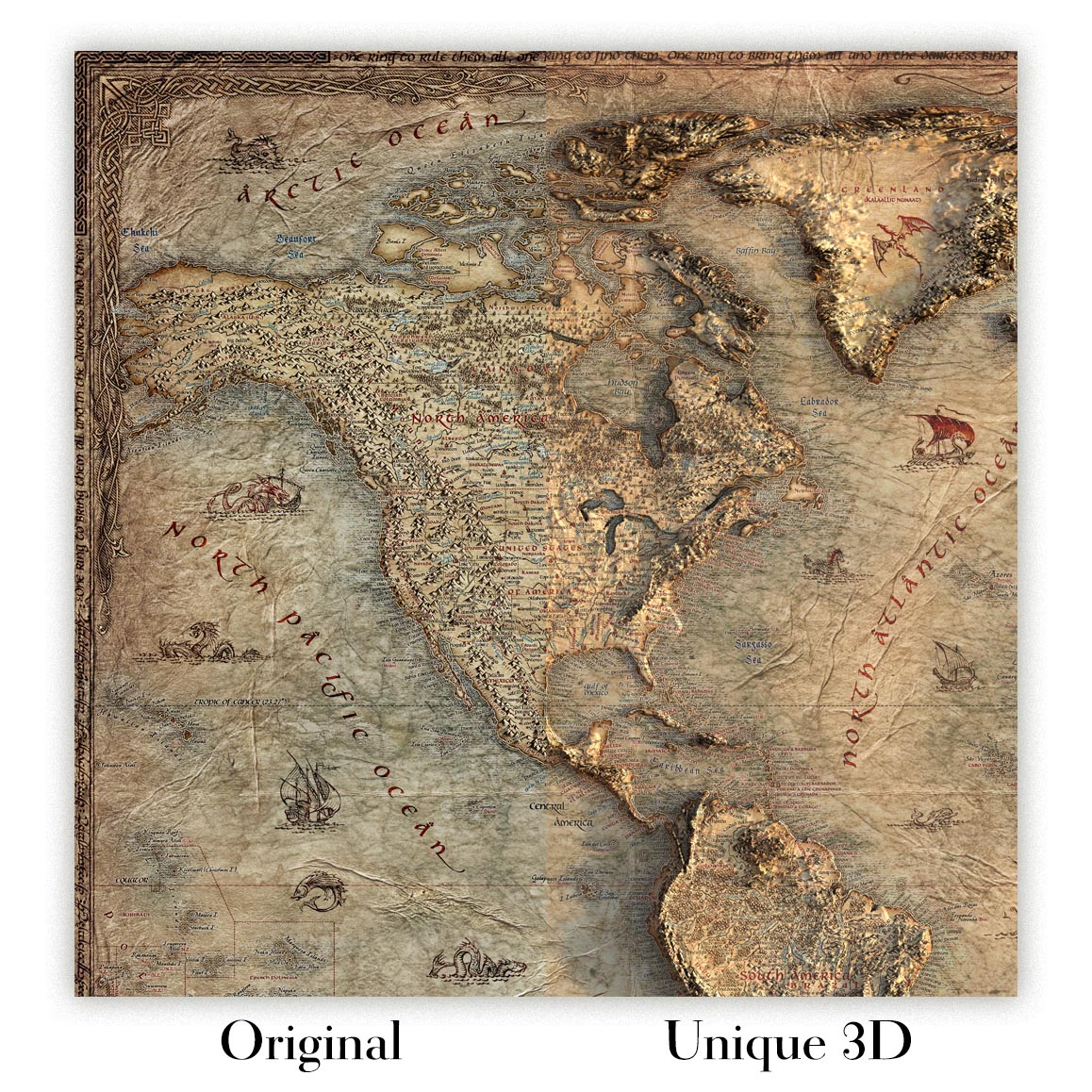
For something truly unique, this map is also available in "Unique 3D", our trademarked process that dramatically transforms the map so that it has a wonderful sense of depth. We combine the original map with detailed topography and elevation data, so that mountains and the terrain really "pop". For more info and examples of 3D maps, check my Unique 3D page.
A Map of Lewis and Clark's Track Across the Western Portion of North America, from the Mississippi to the Pacific Ocean is William Clark’s epochal cartographic summation of the Corps of Discovery, published in 1814. Widely regarded as the most significant printed map of the American West, it compresses an eight-thousand-mile odyssey (1804–1806) into a coherent geography that Americans could finally grasp. Here the sinuous Missouri and the ocean-bound Columbia are set in convincing relation to the Rocky Mountains, sweeping aside generations of conjecture. The map is the first tangible cartographic expression of Thomas Jefferson’s vision of continental reach—an early, formative articulation of Manifest Destiny rendered in the meticulous copperplate idiom of its day, where every river bend, mountain hachure, and annotation serves both science and statecraft.
From the Mississippi’s gateway at St. Louis, Clark’s engraved track ascends the Missouri, threading the tallgrass corridor that would later cradle cities like Kansas City. The river’s great meanders are fixed against prairies studded with Indian settlements and trading grounds, culminating in the cosmopolitan Mandan-Hidatsa villages that anchored winter quarters. Westward, the Missouri fractures into drama: the thunderous Great Falls, the austere White Cliffs, and the revelatory Three Forks, where Clark inscribes the Jefferson, Madison, and Gallatin—new names for new knowledge. True to the expedition’s priority, the sources of the Upper Missouri are treated with uncommon care, their braided courses and portages annotated to show how near, and yet how hard-won, the divide with the Pacific watershed would be.
Crossing the Continental Divide, the map records the lived landscape of the Shoshone, Nez Perce, and Salish homelands, translating guidance from Indigenous knowledge into routes across the Bitterroots and along high-country trails. The expedition’s westward descent is plotted onto “Lewis’s River” (the Snake), the Clearwater, and the Columbia—rivers that become both road and chronicle. The mid-Columbia’s narrows and cataracts are noted, as are the confluences that structure the Northwest: the “Multnomah” (Willamette) near present-day Portland, and the broad estuary where Chinookan villages lined the tidal flats of the lower Columbia. By the time Clark’s engraved track reaches the Pacific, the Northwest emerges not as rumor but as a network—navigable, mapped, and newly intelligible.
Clark was not merely a traveler but an exacting cartographer, distilling field sketches, celestial observations, and painstaking dead reckoning into a single, authoritative image. The map fuses firsthand surveying with knowledge shared by Indigenous leaders and hunters, preserving names, village sites, trails, and resource notes that make it as ethnographic as it is geographic. Early nineteenth-century engraving conventions—fine hachures for relief, elegant river engraving, and an economy of crisp labels—serve a deeply empirical program: to fix places in space and relation. Where earlier depictions trafficked in conjecture, Clark’s work substitutes measured itineraries, explicit portages, and descriptive inscriptions that teach the land as one reads the route.
The influence of the 1814 map radiated for decades. Traders, soldiers, naturalists, and emigrants alike mined its pages to cross the trans-Missouri West, long before railroad surveys and later government expeditions refined its detail. It set foundational principles for mapping the Northwest and the Upper Missouri regions, shaping American geographical consciousness and the practical pathways of overland transit. As the cartographic standard-bearer of the age of exploration, it anchors any collection of Western Americana—an artifact in which narrative, science, and national ambition entwine. In Clark’s engraved track, one sees a continent cohering: rivers converging, mountains yielding their crossings, and the American West resolving from blankness into legible form.
Cities and towns on this map
- St. Louis, Missouri (modern population: approx. 300,000)
- Portland, Oregon (modern population: approx. 650,000)
- Kansas City, Missouri (modern population: approx. 500,000)
Notable Features & Landmarks
- Rivers: Several major rivers, including the Missouri River and Columbia River
- Mountain ranges: Notable mountains such as the Rocky Mountains
- Landmarks: Points indicating Indian settlements and various natural landmarks
- Inscriptions: Descriptive labels for different geographical features, tribal areas, and routes
Historical and design context
- Name: A Map of Lewis and Clark's Track Across the Western Portion of North America, from the Mississippi to the Pacific Ocean
- Mapmaker and date: William Clark, published in 1814
- Created after the Louisiana Purchase to document the Lewis & Clark expedition (1804–1806) and its eight-thousand-mile journey
- Provided the first accurate depiction of key geographic relationships in the Northwest and Upper Missouri River regions
- Regarded as the most significant printed map of the West; cornerstone of Western Americana
- Reflects the first tangible step toward Thomas Jefferson’s vision of Manifest Destiny
- Vital in shaping American geographical knowledge and facilitating overland transit for decades
- Design/style: Intricate early-19th-century engraving with meticulous cartographic techniques
- Coverage focus: Northwestern United States, with special attention to the sources of the Upper Missouri River
- Themes: Exploration and discovery; Manifest Destiny; Indigenous interactions and cultural heritage representation
Please double check the images to make sure that a specific town or place is shown on this map. You can also get in touch and ask us to check the map for you.
This map looks great at every size, but I always recommend going for a larger size if you have space. That way you can easily make out all of the details.
This map looks amazing at sizes all the way up to 100in (250cm). If you are looking for a larger map, please get in touch.
Please note: the labels on this map are hard to read if you order a map that is 16in (40cm) or smaller. The map is still very attractive, but if you would like to read the map easily, please buy a larger size.
This map is wider than most maps, which would make it a perfect statement piece above a mantelpiece, sofa or desk.
The fifth listing image shows an example of my map personalisation service.
If you’re looking for something slightly different, check out my collection of the best old maps to see if something else catches your eye.
Please contact me to check if a certain location, landmark or feature is shown on this map.
This would make a wonderful birthday, Christmas, Father's Day, work leaving, anniversary or housewarming gift for someone from the areas covered by this map.
This map is available as a giclée print on acid free archival matte paper, or you can buy it framed. The frame is a nice, simple black frame that suits most aesthetics. Please get in touch if you'd like a different frame colour or material. My frames are glazed with super-clear museum-grade acrylic (perspex/acrylite), which is significantly less reflective than glass, safer, and will always arrive in perfect condition.
This map is also available as a float framed canvas, sometimes known as a shadow gap framed canvas or canvas floater. The map is printed on artist's cotton canvas and then stretched over a handmade box frame. We then "float" the canvas inside a wooden frame, which is available in a range of colours (black, dark brown, oak, antique gold and white). This is a wonderful way to present a map without glazing in front. See some examples of float framed canvas maps and explore the differences between my different finishes.
For something truly unique, this map is also available in "Unique 3D", our trademarked process that dramatically transforms the map so that it has a wonderful sense of depth. We combine the original map with detailed topography and elevation data, so that mountains and the terrain really "pop". For more info and examples of 3D maps, check my Unique 3D page.
Molte delle nostre mappe e stampe d’arte vengono scelte come regali premurosi per case, uffici, studi e luoghi significativi.
Scegli un’opzione incorniciata per il regalo più semplice, pronto da appendere, oppure scegli una stampa non incorniciata se il destinatario preferisce selezionare la propria cornice.
Realizziamo gli ordini localmente in 23 paesi in tutto il mondo, così i regali possono spesso essere prodotti vicino al destinatario. Questo li aiuta ad arrivare più rapidamente, a viaggiare in maggiore sicurezza e a evitare sorprese legate a dazi doganali o di importazione.
- Possiamo consegnare direttamente al destinatario
- I pezzi incorniciati arrivano pronti da appendere
- Le stampe non incorniciate sono accuratamente imballate in un robusto tubo protettivo
- Quasi ogni ordine viene realizzato localmente, per regali più rapidi e sicuri
- Il reso entro 90 giorni dà al destinatario il tempo di decidere
Se non sei sicuro di cosa scegliere, ti invitiamo a contattarci. Possiamo aiutarti a scegliere la mappa, il formato, la finitura o l’opzione di consegna più adatti.
Most orders are made locally and delivered in around 2–3 working days, depending on the product, size and destination.
We print and frame maps and artwork in 24 countries around the world, so your order is usually made close to you or your recipient. That means faster delivery, less time in transit, and no customs or import duty surprises.
Personalised and customised pieces usually take an extra 1–2 working days, because we prepare your design and send it to you for approval before printing.
Very large framed orders can take a little longer, as they need extra care in production and delivery.
Every order is carefully packaged: unframed prints are sent in a strong protective tube, while framed pieces are securely packed with protective materials around the frame.
If you need your order by a particular date, please contact us before ordering. We’ll check the best production route and delivery option for your location.
Express delivery is available at checkout for most countries. Next-day delivery is available in the UK, US, Singapore and the UAE.
Your order is covered by our 90-day returns policy and 10-year guarantee.
Our standard frame is a gallery-style black ash hardwood frame, with a simple, modern look. It is approximately 20mm (0.8in) wide. You can also view some lovely customer photos of framed maps and art.
We use super-clear acrylic glazing, also known as Perspex or Acrylite, instead of traditional glass. It is lighter, safer, and has lower reflectivity, giving the artwork a clearer, cleaner appearance.
Six standard frame colours are available at no extra cost: black, dark brown, dark grey, oak, white, and antique gold. Custom framing and mounting/matting is also available for customers looking for something more specific.
Most maps, art prints, and illustrations are also available as a framed canvas. We use matte cotton canvas, stretch it over a sustainably sourced wooden box frame, and then float the piece within a wooden outer frame. The finished result is beautifully presented, with no glazing between you and the artwork.
All frames are supplied ready to hang, with either string or brackets fitted to the back. Very large frames will include heavy-duty hanging plates and/or a mounting baton. If you have any questions, please get in touch.
We can also supply old maps and artwork on canvas, foam board, cotton rag, and other materials.
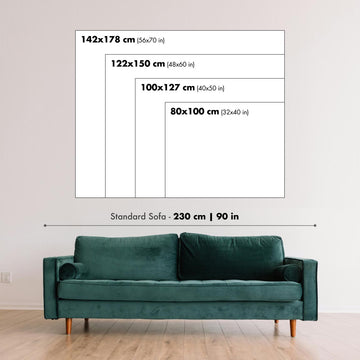
If you would prefer to frame your map or artwork yourself, please read our size guide before ordering.
Lavoriamo con interior designer, strutture ricettive, professionisti del settore immobiliare, uffici e acquirenti aziendali su singoli pezzi e su progetti coordinati di più ampia portata.
Questa mappa può essere adattata a una particolare parete, stanza o progetto, e il nostro laboratorio può aiutare a coordinare dimensioni, materiale e incorniciatura prima della produzione.
- Dimensioni precise, extra-large e su misura
- Incorniciatura, montaggio e materiali alternativi personalizzati
- Pezzi coordinati per più stanze o sedi
- Personalizzazione della mappa, per evidenziare luoghi importanti o aggiungere dettagli supplementari
- Consulenza su mappa e incorniciatura dal nostro laboratorio
- Produzione locale per progetti in tutto il mondo
Every Unique Maps piece begins with an authentic cartographic source or an original design from our London studio.
For our historic maps, we source rare originals from libraries, archives, auction houses and private collections around the world. We carefully restore each map for print—repairing age-related damage, balancing colour and improving clarity while preserving its original detail, texture and character.
Once restored, the map is prepared for your chosen size and finish. Your piece is then printed and, where selected, framed close to its delivery destination.
Our map prints use acid-free 200gsm archival matte paper and fade-resistant pigment inks, creating a rich, non-glossy finish designed to last. Framed maps use crystal-clear optical acrylic and arrive ready to hang.
Canvas, cotton-rag and other specialist presentations are also available. Learn more about our materials and finishes.
Personalising your map
You can add a short title or dedication, mark one meaningful place, or request one considered visual detail. For personalised designs, we send a proof before printing and you can request changes before approval.
For more complex bespoke commissions, contact our design team.
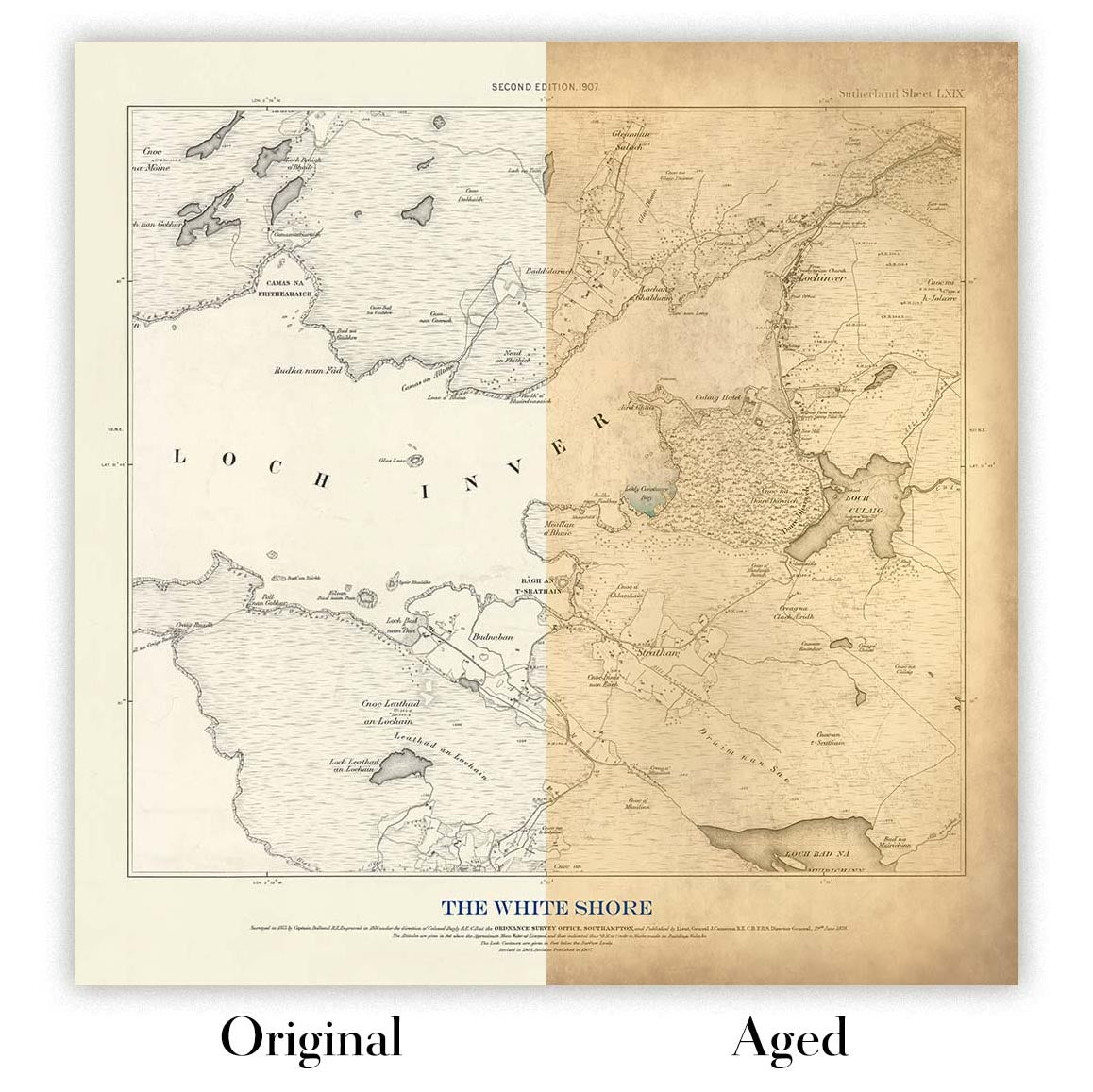
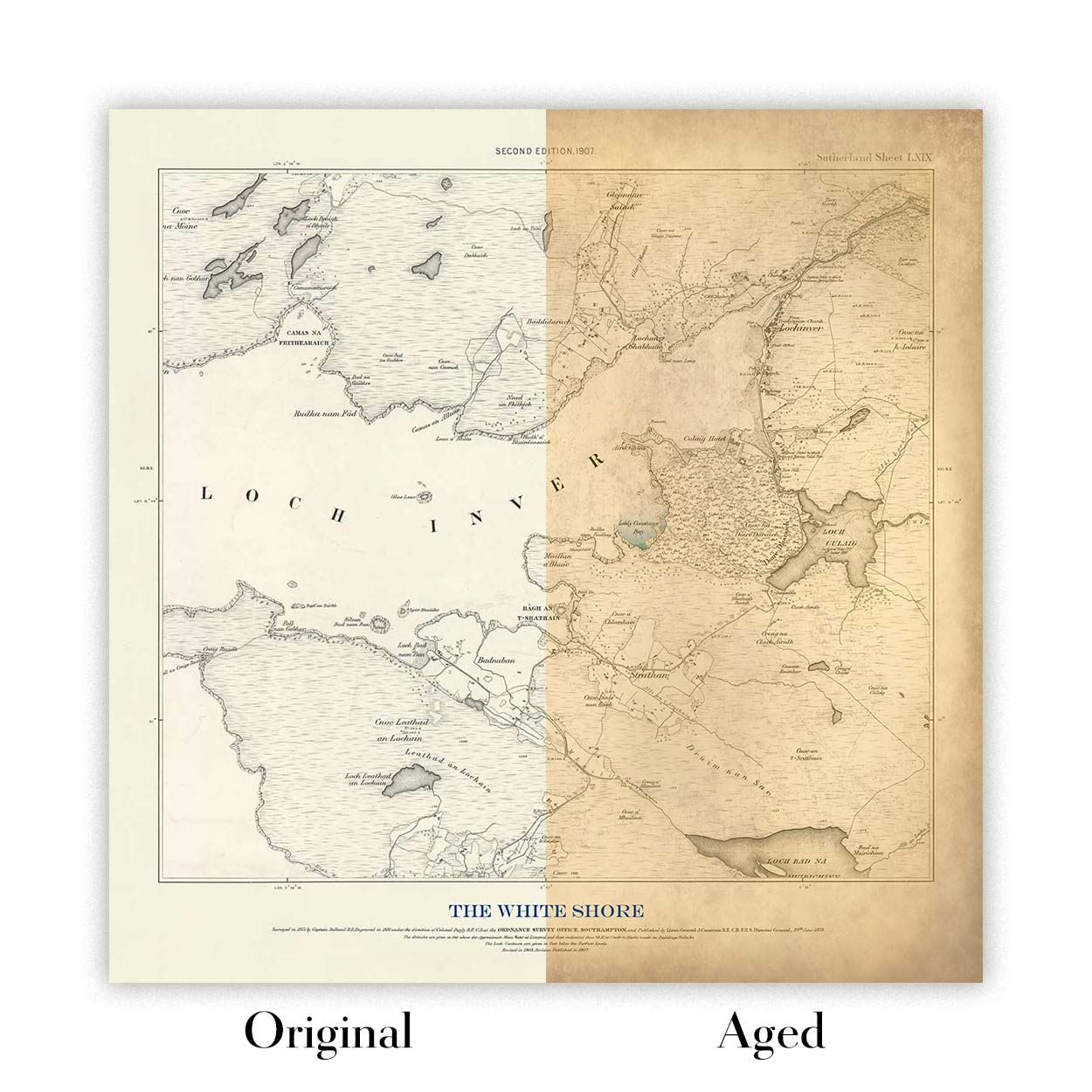
Original or Aged
Choose Original for true-to-source colour, or Aged for a warmer, richer antique character created with our specialist ageing process. See examples of our Aged maps.
Restauriamo e produciamo mappe e stampe d’arte dal 1984, e garantiamo personalmente ogni pezzo.
Ogni ordine è coperto dalla nostra garanzia di 10 anni e dalla garanzia di consegna senza danni. Se il vostro pezzo arriva danneggiato, lo sostituiremo o lo rifaremo gratuitamente. Se qualsiasi altro aspetto non fosse conforme, contattate il nostro team di laboratorio e provvederemo tempestivamente a risolvere il problema.
Per tutti i dettagli, consultate la nostra politica su resi e rimborsi.
Oppure cerca qualcosa nel negozio.


