














Rare Old Pictorial Map of Texas by Oliver, 1965: Houston, Dallas, San Antonio, Austin, Big Bend
Restaurée dans notre atelier londonien à partir de la carte originale de 1965 et imprimée en qualité musée. Description complète
L’offre du collectionneur
Choisissez deux œuvres éligibles et bénéficiez de 20 % de réduction sur les deux. Choisissez-en trois et celle au prix le plus bas est offerte, pour une économie maximale de 33 %.
Associez librement des cartes standard éligibles et des tirages d’art. Aucun code n’est requis ; l’offre est appliquée automatiquement lors du paiement.
Les configurations standard réalisées sur commande sont incluses. Les formats sur mesure, les créations personnalisées et les œuvres commissionnées sont exclus.
Besoin d’une livraison à différentes adresses ? Contactez-nous avant de commander.L’offre du collectionneur
Choisissez deux œuvres éligibles et bénéficiez de 20 % de réduction sur les deux. Choisissez-en trois et celle au prix le plus bas est offerte, pour une économie maximale de 33 %.
Associez librement des cartes standard éligibles et des tirages d’art. Aucun code n’est requis ; l’offre est appliquée automatiquement lors du paiement.
Les configurations standard réalisées sur commande sont incluses. Les formats sur mesure, les créations personnalisées et les œuvres commissionnées sont exclus.
Besoin d’une livraison à différentes adresses ? Contactez-nous avant de commander. Restauré à Londres • Imprimé et encadré dans l’UE

Restaurée à partir de la carte originale de 1965 et imprimée en qualité musée. Description complète
Choisissez votre format
Choisissez votre finition


(Plus d’infos)
Message cadeau & finition personnalisée

Si vous souhaitez ajouter un message cadeau, ou une finition (puzzle, panneau en aluminium, etc.) qui n'est pas disponible ici, veuillez le demander dans la "note de commande" lors de votre passage à la caisse.
Chaque commande est fabriquée sur mesure, donc si vous avez besoin d'ajuster légèrement la taille, ou d'imprimer sur un matériau inhabituel, faites-le nous savoir. Nous avons réalisé des milliers de commandes personnalisées au fil des ans, donc il n'y a (presque) rien que nous ne puissions gérer.
Vous pouvez également nous contacter avant de passer votre commande, si vous le souhaitez !
Faites entrer un morceau d’histoire chez vous
Plus de 8 000 avis 5 étoiles


A Texan’s Map of the United States (of Texas), drawn in 1965 by Frank Oliver and issued by the Texoak Flooring Company...
Continuer la lectureA Texan’s Map of the United States (of Texas), drawn in 1965 by Frank Oliver and issued by the Texoak Flooring Company of Crockett, revels in a winking boast: Texas at the center of everything. Its tongue‑in‑cheek title captures the buoyant mid‑century swagger that animates the composition, while a richly ornamented cartouche frames key scenes and lends the whole a ceremonious flourish. Oliver’s pictorial style—crowded with lively vignettes, crisply lettered labels, and a tidy legend of symbols—combines the authority of a reference with the charm of a travel poster. Neighboring states and international borders are present, but the eye is irresistibly pulled back to the Lone Star, its cities, parklands, and economic engines rendered with affectionate precision. This is Texas as both locale and idea, distinctly 1965 and unmistakably itself.
The geography unfurls as an illustrated atlas of moods and terrains. Blue ribbons trace the Rio Grande, Red, and Sabine Rivers, their courses visually anchoring edges and corridors of history, while stylized peaks wink toward the Guadalupe Mountains and the long tablelands of the Llano Estacado. The Gulf shoreline curls in a scalloped band of surf and shipping lanes, dotted with barrier islands and the arc of Padre Island National Seashore. To the west, desert austerity resolves into the rugged drama of Big Bend; to the heart, the Hill Country stirs with spring‑fed streams and limestone ridges along the Balcones Escarpment. Oliver knits these physiographic notes into a coherent stage on which Texas plays large, placing the state’s familiar outline against its neighbors with confident, celebratory proportion.
Cities become narrative chapters told through icons and emblems. Houston, close to the Gulf and the Ship Channel, bristles with refineries and a nod to the era’s Manned Spacecraft Center, capturing the thrill of the Space Age. San Antonio pairs mission arches with the Alamo’s unmistakable silhouette, while Dallas and Fort Worth balance modern skylines with stockyard energy. Austin, at the crossroads of rivers and hills, radiates governmental gravitas and cultural verve. El Paso anchors the Trans‑Pecos, gatekeeping the desert frontier, and Corpus Christi fronts the coast with maritime bustle. Rivers—Trinity, Brazos, Colorado—thread these urban scenes together like bright cords, and highways and rail lines hint at circulation and exchange. The effect is a mosaic of places that reads as a living itinerary as much as a map.
Economic landscapes are given equal stagecraft, and Oliver’s legend decodes them with spry efficiency. The Texas Citrus Belt ripens along the lower Rio Grande, its orchards set against irrigation lines and valley towns. Oil derricks prick the horizon from the Permian Basin to the Gulf Coast, converging with refineries near Houston in a visual grammar of pipes, tanks, and flame tips. The East Texas forests shade lumber and paper, while cattle and cotton pattern the Panhandle and Blackland Prairie in alternating textures of herd and furrow. Ports, pipelines, and railheads interlock, suggesting a state whose wealth runs from wellhead and grove to ship and sky. In 1965—on the cusp of new technologies and enduring industries—this is economic cartography as both inventory and invitation.
Frank Oliver’s authorship, published under the aegis of a proud Texas manufacturer, threads artistry with civic boosterism. His line has the sprightly confidence of mid‑century American pictorial mapping: humorous without caricature, informative without clutter, and anchored by a handsome cartouche that concentrates emblematic scenes into a heraldic frame. The legend’s symbols—neatly marshaled and consistently applied—tune the map’s exuberance into legibility. In the wider current of 1960s America—civil rights debates, suburban expansion, and a skyward glance toward the Moon—the map stands as a capsule of Texan self‑imagination, fusing frontier memory with modern might. It reads like a love letter and a ledger, a festive portrait of a state that insists, with generous confidence, on being the largest story on the page.
Cities and towns on this map
- Houston (Modern-day population: ~2.3 million)
- San Antonio (Modern-day population: ~1.5 million)
- Dallas (Modern-day population: ~1.3 million)
- Austin (Modern-day population: ~1 million)
- Fort Worth (Modern-day population: ~935,000)
- El Paso (Modern-day population: ~680,000)
- Corpus Christi (Modern-day population: ~325,000)
Notable Features & Landmarks
- Decorative cartouche that frames significant areas of the map.
- Illustrations of key landmarks such as state parks, historical sites, and major cities.
- Indication of economic regions, like the Texas Citrus Belt and oil fields.
- Visual cues that represent geographical features like rivers and mountains.
- Legend detailing symbols used throughout the map.
Historical and design context
- Creation Date: 1965
- Mapmaker/Publisher: Created by Frank Oliver; published by Texoak Flooring Company, Crockett, Texas.
- Mapmaker Context: Texoak Flooring Company, known as a manufacturer of Texas oak products, suggests a local interest in promoting Texan heritage and landscapes through this map.
- Themes: The map focuses on Texas within the context of the United States, showcasing its geographical features, cultural significance, and economic role during the 1960s.
- Design Style: The map is characterized by a pictorial and thematic representation, prominently using illustrations and decorative elements, which reflect mid-20th-century American cartographic style.
- Historical Significance: The map serves as an artifact encapsulating Texas's identity during a time of cultural revolution and expansion in the U.S., highlighting its historical boundaries and economic contexts.
Please double check the images to make sure that a specific town or place is shown on this map. You can also get in touch and ask us to check the map for you.
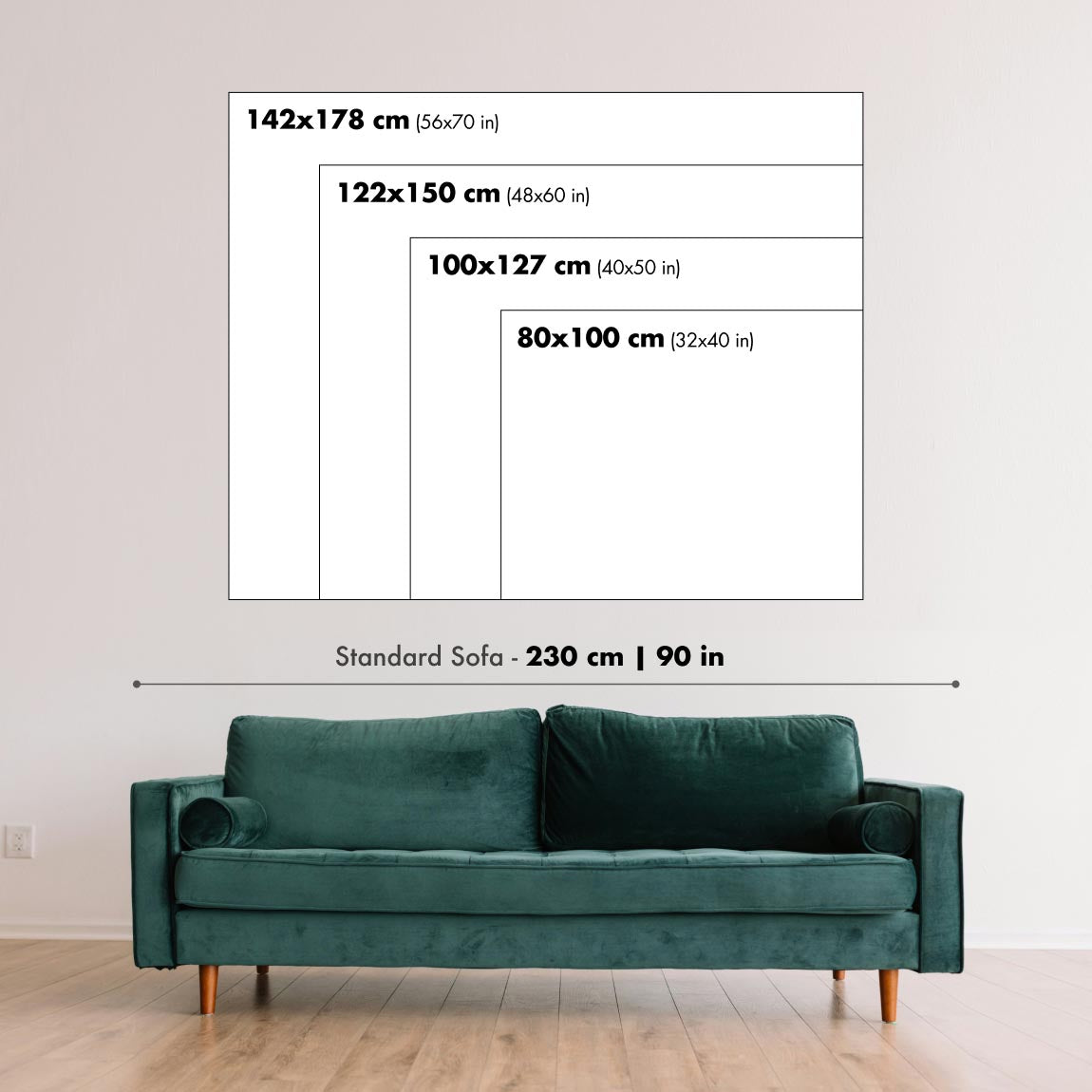
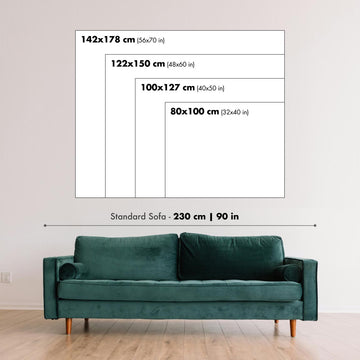
This map looks great at every size, but I always recommend going for a larger size if you have space. That way you can easily make out all of the details.
This map looks amazing at sizes all the way up to 100in (250cm). If you are looking for a larger map, please get in touch.
The model in the listing images is holding the 18x24in (45x60cm) version of this map.
The fifth listing image shows an example of my map personalisation service.
If you’re looking for something slightly different, check out my collection of the best old maps to see if something else catches your eye.
Please contact me to check if a certain location, landmark or feature is shown on this map.
This would make a wonderful birthday, Christmas, Father's Day, work leaving, anniversary or housewarming gift for someone from the areas covered by this map.
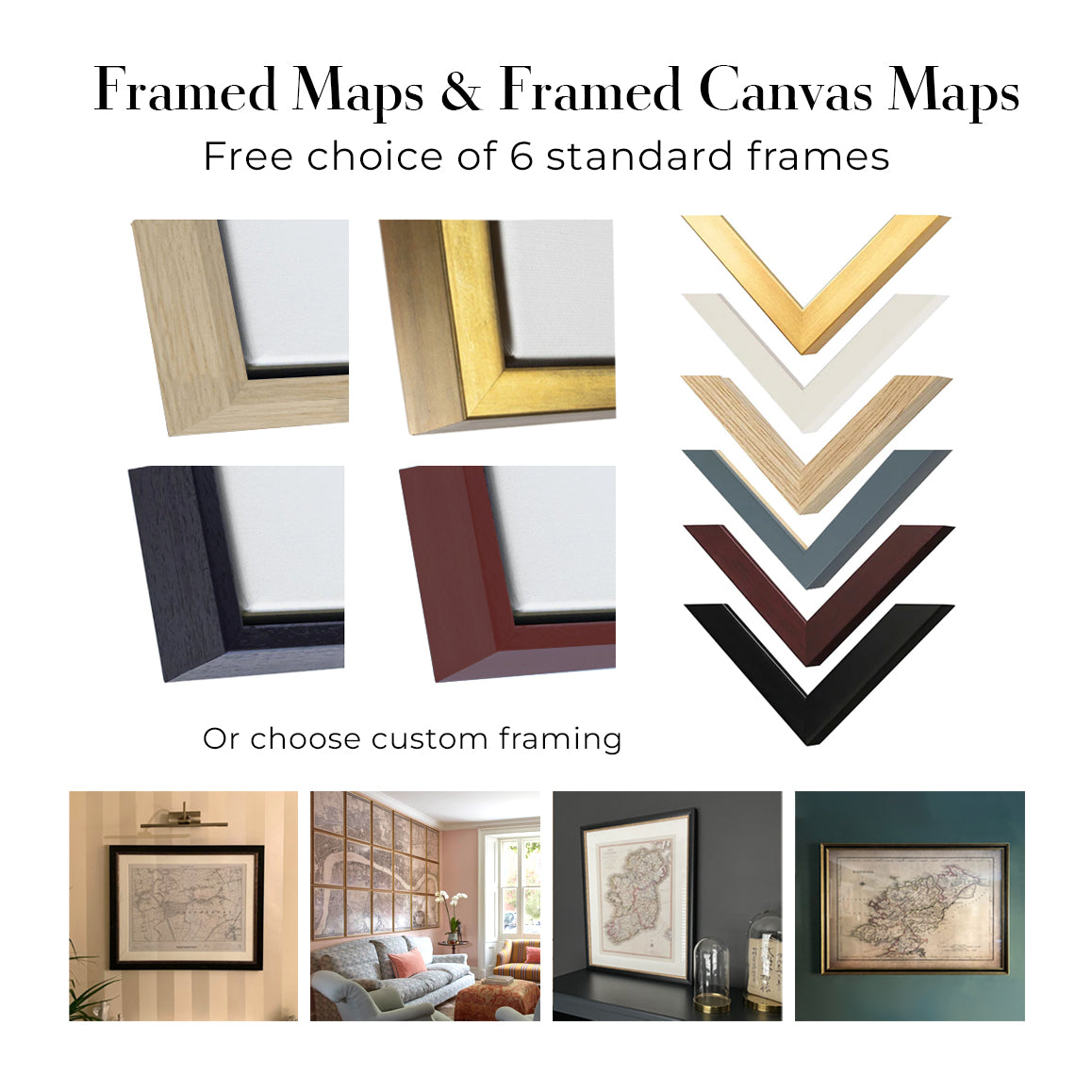
This map is available as a giclée print on acid free archival matte paper, or you can buy it framed. The frame is a nice, simple black frame that suits most aesthetics. Please get in touch if you'd like a different frame colour or material. My frames are glazed with super-clear museum-grade acrylic (perspex/acrylite), which is significantly less reflective than glass, safer, and will always arrive in perfect condition.
This map is also available as a float framed canvas, sometimes known as a shadow gap framed canvas or canvas floater. The map is printed on artist's cotton canvas and then stretched over a handmade box frame. We then "float" the canvas inside a wooden frame, which is available in a range of colours (black, dark brown, oak, antique gold and white). This is a wonderful way to present a map without glazing in front. See some examples of float framed canvas maps and explore the differences between my different finishes.
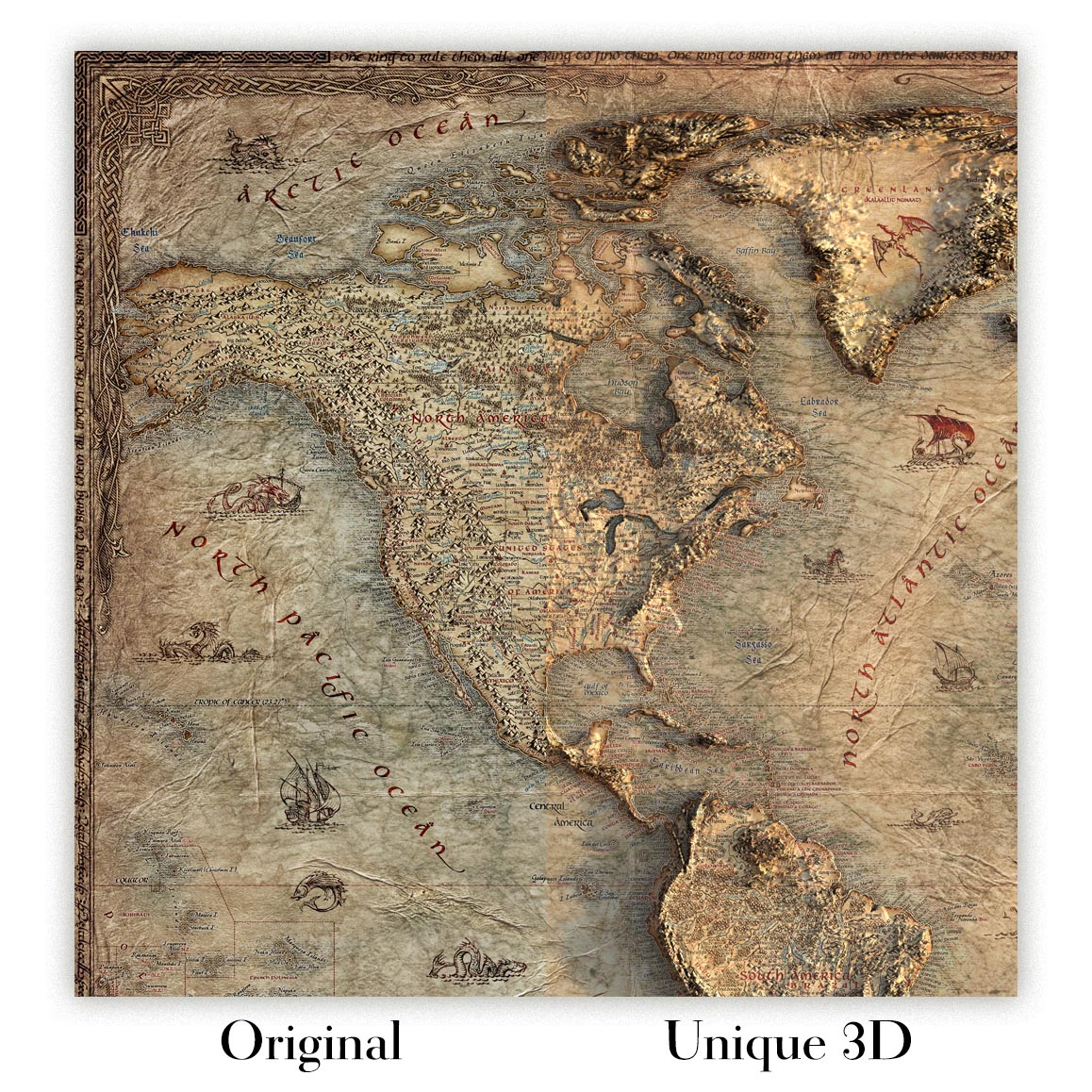
For something truly unique, this map is also available in "Unique 3D", our trademarked process that dramatically transforms the map so that it has a wonderful sense of depth. We combine the original map with detailed topography and elevation data, so that mountains and the terrain really "pop". For more info and examples of 3D maps, check my Unique 3D page.
A Texan’s Map of the United States (of Texas), drawn in 1965 by Frank Oliver and issued by the Texoak Flooring Company of Crockett, revels in a winking boast: Texas at the center of everything. Its tongue‑in‑cheek title captures the buoyant mid‑century swagger that animates the composition, while a richly ornamented cartouche frames key scenes and lends the whole a ceremonious flourish. Oliver’s pictorial style—crowded with lively vignettes, crisply lettered labels, and a tidy legend of symbols—combines the authority of a reference with the charm of a travel poster. Neighboring states and international borders are present, but the eye is irresistibly pulled back to the Lone Star, its cities, parklands, and economic engines rendered with affectionate precision. This is Texas as both locale and idea, distinctly 1965 and unmistakably itself.
The geography unfurls as an illustrated atlas of moods and terrains. Blue ribbons trace the Rio Grande, Red, and Sabine Rivers, their courses visually anchoring edges and corridors of history, while stylized peaks wink toward the Guadalupe Mountains and the long tablelands of the Llano Estacado. The Gulf shoreline curls in a scalloped band of surf and shipping lanes, dotted with barrier islands and the arc of Padre Island National Seashore. To the west, desert austerity resolves into the rugged drama of Big Bend; to the heart, the Hill Country stirs with spring‑fed streams and limestone ridges along the Balcones Escarpment. Oliver knits these physiographic notes into a coherent stage on which Texas plays large, placing the state’s familiar outline against its neighbors with confident, celebratory proportion.
Cities become narrative chapters told through icons and emblems. Houston, close to the Gulf and the Ship Channel, bristles with refineries and a nod to the era’s Manned Spacecraft Center, capturing the thrill of the Space Age. San Antonio pairs mission arches with the Alamo’s unmistakable silhouette, while Dallas and Fort Worth balance modern skylines with stockyard energy. Austin, at the crossroads of rivers and hills, radiates governmental gravitas and cultural verve. El Paso anchors the Trans‑Pecos, gatekeeping the desert frontier, and Corpus Christi fronts the coast with maritime bustle. Rivers—Trinity, Brazos, Colorado—thread these urban scenes together like bright cords, and highways and rail lines hint at circulation and exchange. The effect is a mosaic of places that reads as a living itinerary as much as a map.
Economic landscapes are given equal stagecraft, and Oliver’s legend decodes them with spry efficiency. The Texas Citrus Belt ripens along the lower Rio Grande, its orchards set against irrigation lines and valley towns. Oil derricks prick the horizon from the Permian Basin to the Gulf Coast, converging with refineries near Houston in a visual grammar of pipes, tanks, and flame tips. The East Texas forests shade lumber and paper, while cattle and cotton pattern the Panhandle and Blackland Prairie in alternating textures of herd and furrow. Ports, pipelines, and railheads interlock, suggesting a state whose wealth runs from wellhead and grove to ship and sky. In 1965—on the cusp of new technologies and enduring industries—this is economic cartography as both inventory and invitation.
Frank Oliver’s authorship, published under the aegis of a proud Texas manufacturer, threads artistry with civic boosterism. His line has the sprightly confidence of mid‑century American pictorial mapping: humorous without caricature, informative without clutter, and anchored by a handsome cartouche that concentrates emblematic scenes into a heraldic frame. The legend’s symbols—neatly marshaled and consistently applied—tune the map’s exuberance into legibility. In the wider current of 1960s America—civil rights debates, suburban expansion, and a skyward glance toward the Moon—the map stands as a capsule of Texan self‑imagination, fusing frontier memory with modern might. It reads like a love letter and a ledger, a festive portrait of a state that insists, with generous confidence, on being the largest story on the page.
Cities and towns on this map
- Houston (Modern-day population: ~2.3 million)
- San Antonio (Modern-day population: ~1.5 million)
- Dallas (Modern-day population: ~1.3 million)
- Austin (Modern-day population: ~1 million)
- Fort Worth (Modern-day population: ~935,000)
- El Paso (Modern-day population: ~680,000)
- Corpus Christi (Modern-day population: ~325,000)
Notable Features & Landmarks
- Decorative cartouche that frames significant areas of the map.
- Illustrations of key landmarks such as state parks, historical sites, and major cities.
- Indication of economic regions, like the Texas Citrus Belt and oil fields.
- Visual cues that represent geographical features like rivers and mountains.
- Legend detailing symbols used throughout the map.
Historical and design context
- Creation Date: 1965
- Mapmaker/Publisher: Created by Frank Oliver; published by Texoak Flooring Company, Crockett, Texas.
- Mapmaker Context: Texoak Flooring Company, known as a manufacturer of Texas oak products, suggests a local interest in promoting Texan heritage and landscapes through this map.
- Themes: The map focuses on Texas within the context of the United States, showcasing its geographical features, cultural significance, and economic role during the 1960s.
- Design Style: The map is characterized by a pictorial and thematic representation, prominently using illustrations and decorative elements, which reflect mid-20th-century American cartographic style.
- Historical Significance: The map serves as an artifact encapsulating Texas's identity during a time of cultural revolution and expansion in the U.S., highlighting its historical boundaries and economic contexts.
Please double check the images to make sure that a specific town or place is shown on this map. You can also get in touch and ask us to check the map for you.
This map looks great at every size, but I always recommend going for a larger size if you have space. That way you can easily make out all of the details.
This map looks amazing at sizes all the way up to 100in (250cm). If you are looking for a larger map, please get in touch.
The model in the listing images is holding the 18x24in (45x60cm) version of this map.
The fifth listing image shows an example of my map personalisation service.
If you’re looking for something slightly different, check out my collection of the best old maps to see if something else catches your eye.
Please contact me to check if a certain location, landmark or feature is shown on this map.
This would make a wonderful birthday, Christmas, Father's Day, work leaving, anniversary or housewarming gift for someone from the areas covered by this map.
This map is available as a giclée print on acid free archival matte paper, or you can buy it framed. The frame is a nice, simple black frame that suits most aesthetics. Please get in touch if you'd like a different frame colour or material. My frames are glazed with super-clear museum-grade acrylic (perspex/acrylite), which is significantly less reflective than glass, safer, and will always arrive in perfect condition.
This map is also available as a float framed canvas, sometimes known as a shadow gap framed canvas or canvas floater. The map is printed on artist's cotton canvas and then stretched over a handmade box frame. We then "float" the canvas inside a wooden frame, which is available in a range of colours (black, dark brown, oak, antique gold and white). This is a wonderful way to present a map without glazing in front. See some examples of float framed canvas maps and explore the differences between my different finishes.
For something truly unique, this map is also available in "Unique 3D", our trademarked process that dramatically transforms the map so that it has a wonderful sense of depth. We combine the original map with detailed topography and elevation data, so that mountains and the terrain really "pop". For more info and examples of 3D maps, check my Unique 3D page.
Nombre de nos cartes et tirages d’art sont choisis comme cadeaux attentionnés pour des intérieurs, des bureaux, des cabinets de travail et des lieux chargés de sens.
Choisissez une option encadrée pour un cadeau prêt à être accroché en toute simplicité, ou optez pour un tirage non encadré si le destinataire préfère peut-être sélectionner son propre cadre.
Nous fabriquons les commandes localement dans 23 pays à travers le monde, afin que les cadeaux puissent souvent être produits à proximité du destinataire. Cela permet une livraison plus rapide, un transport plus sûr et d’éviter les surprises liées aux frais de douane ou droits d’importation.
- Nous pouvons livrer directement au destinataire
- Les pièces encadrées arrivent prêtes à être accrochées
- Les tirages non encadrés sont soigneusement emballés dans un tube de protection robuste
- Presque chaque commande est fabriquée localement, pour des cadeaux plus rapides et plus sûrs
- Les retours sous 90 jours laissent au destinataire le temps de se décider
Si vous hésitez sur le choix à faire, veuillez nous contacter. Nous pouvons vous aider à choisir la carte, le format, la finition ou l’option de livraison appropriés.
Pour la plupart des commandes, le délai de livraison est d'environ 3 jours ouvrables. Les produits personnalisés et sur mesure prennent plus de temps, car je dois faire la personnalisation et vous l'envoyer pour approbation, ce qui prend généralement 1 ou 2 jours.
Veuillez noter que les grandes commandes encadrées prennent généralement plus de temps à réaliser et à livrer.
Si vous avez besoin que votre commande arrive à une date précise, veuillez me contacter avant de passer votre commande afin que nous puissions trouver le meilleur moyen de nous assurer que vous receviez votre commande à temps.
J'imprime et encadre des cartes et des œuvres d'art dans 23 pays à travers le monde. Cela signifie que votre commande sera réalisée localement, ce qui réduit le temps de livraison et garantit qu'elle ne sera pas endommagée pendant le transport. Vous ne paierez jamais de droits de douane ou d'importation, et nous mettrons moins de CO2 dans l'air.
Toutes mes cartes et impressions artistiques sont bien emballées et envoyées dans un tube robuste si non encadrées, ou entourées de mousse si encadrées.
J'essaie d'envoyer toutes les commandes dans les 1 ou 2 jours suivant la réception de votre commande, bien que certains produits (comme les masques, les mugs et les sacs fourre-tout) puissent prendre plus de temps à réaliser.
Si vous choisissez Livraison Express lors du paiement, nous donnerons la priorité à votre commande et l'enverrons par un service de messagerie de 1 jour (Fedex, DHL, UPS, Parcelforce).
La livraison le lendemain est également disponible dans certains pays (États-Unis, Royaume-Uni, Singapour, Émirats Arabes Unis), mais veuillez essayer de commander tôt dans la journée afin que nous puissions l'envoyer à temps.
Lisez mon guide complet sur la livraison et la production locale
Mon cadre standard est un cadre en bois dur noir de style galerie. Il est simple et a un aspect assez moderne. Mon cadre standard mesure environ 20 mm (0,8 po) de large.
J'utilise de l'acrylique super clair (perspex/acrylite) pour le verre du cadre. C'est plus léger et plus sûr que le verre - et cela a meilleur aspect, car la réflexivité est plus faible.
Six couleurs de cadre standard sont disponibles gratuitement (noir, marron foncé, gris foncé, chêne, blanc et or antique). Des encadrements et montages/matelassages personnalisés sont disponibles si vous recherchez autre chose.
La plupart des cartes, œuvres d'art et illustrations sont également disponibles sous forme de toile encadrée. Nous utilisons une toile en coton mate (non brillante), que nous tendons sur un cadre en bois de boîte provenant de sources durables, puis nous 'flottions' la pièce à l'intérieur d'un cadre en bois. Le résultat final est assez beau, et il n'y a pas de vitrage qui gêne.
Tous les cadres sont fournis "prêts à accrocher", avec soit une corde, soit des supports à l'arrière. Les très grands cadres auront des plaques de suspension lourdes et/ou une latte de montage. Si vous avez des questions, veuillez nous contacter.
Voir quelques exemples de mes cartes encadrées et de cartes en toile encadrées.
Alternativement, je peux également fournir de vieilles cartes et œuvres d'art sur toile, sur panneau en mousse, en coton et d'autres matériaux.
Si vous souhaitez encadrer votre carte ou œuvre d'art vous-même, veuillez lire d'abord mon guide des tailles.
Nous travaillons avec des architectes d’intérieur, des acteurs de l’hôtellerie, des professionnels de l’immobilier, des bureaux et des acheteurs corporate, pour des pièces individuelles comme pour des projets coordonnés de plus grande envergure.
Cette carte peut être adaptée à un mur, une pièce ou un projet particulier, et notre atelier peut vous aider à coordonner les dimensions, le matériau et l’encadrement avant la production.
- Dimensions exactes, hors format et sur mesure
- Encadrement, montage et matériaux alternatifs sur mesure
- Pièces coordonnées pour plusieurs pièces ou sites
- Personnalisation de la carte, pour marquer des lieux importants ou ajouter des détails supplémentaires
- Conseils sur la carte et l’encadrement par notre atelier
- Production locale pour des projets dans le monde entier
Échangez au sujet de cette pièce avec notre équipe Trade & Projects
Mes cartes sont des reproductions de cartes originales de très haute qualité.
Je recherche des cartes originales et rares auprès de bibliothèques, de maisons de ventes aux enchères et de collections privées du monde entier, je les restaure dans mon atelier de Londres, puis j'utilise des encres et des imprimantes giclées spécialisées pour créer de magnifiques cartes encore plus belles que l'originale.
Mes cartes sont imprimées sur du papier d’archives mat (non brillant) sans acide qui semble de très haute qualité et ressemble presque à une carte. En termes techniques, le grammage/épaisseur du papier est de 10 mil/200 g/m². C'est parfait pour l'encadrement.
J’imprime avec des encres pigmentaires Epson ultrachrome giclée UV résistantes à la décoloration – certaines des meilleures encres que vous puissiez trouver.
je peux aussi faire cartes sur toile, chiffon en coton et autres matériaux exotiques.
En savoir plus sur Unique Maps Co..
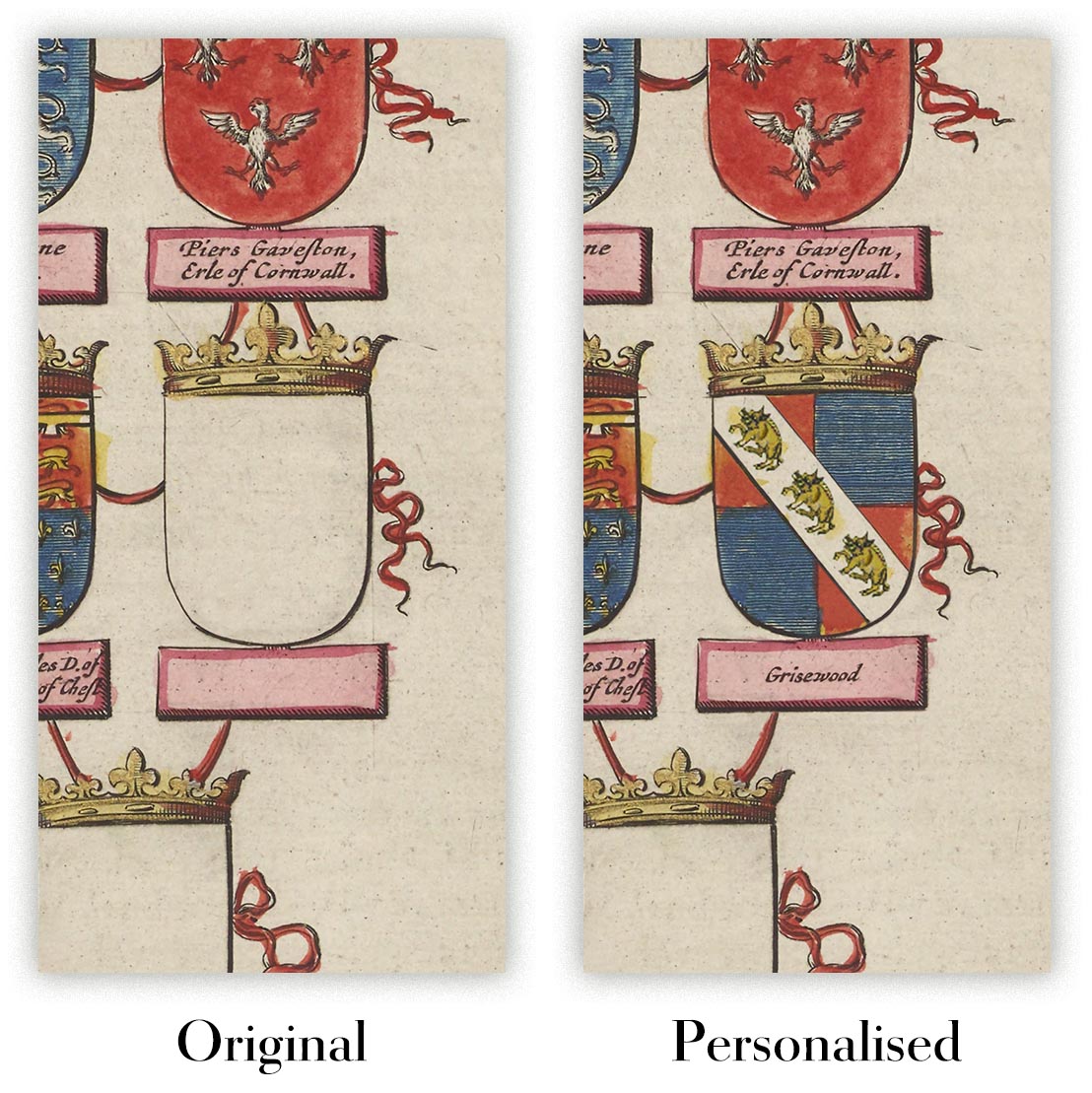
Personnalisation de la carte
Si vous recherchez le cadeau parfait pour un anniversaire ou une pendaison de crémaillère, je peux personnaliser votre carte pour la rendre vraiment unique. Par exemple, je peux ajouter un court message, mettre en évidence un lieu important ou ajouter les armoiries de votre famille.
Les options sont presque infinies. S'il vous plaît voir mon page de personnalisation de la carte pour quelques merveilleux exemples de ce qui est possible.
Pour commander une carte personnalisée, sélectionnez « personnaliser votre carte » avant de l'ajouter à votre panier.
Entrer en contact si vous recherchez des personnalisations et des personnalisations plus complexes.
Vieillissement de la carte
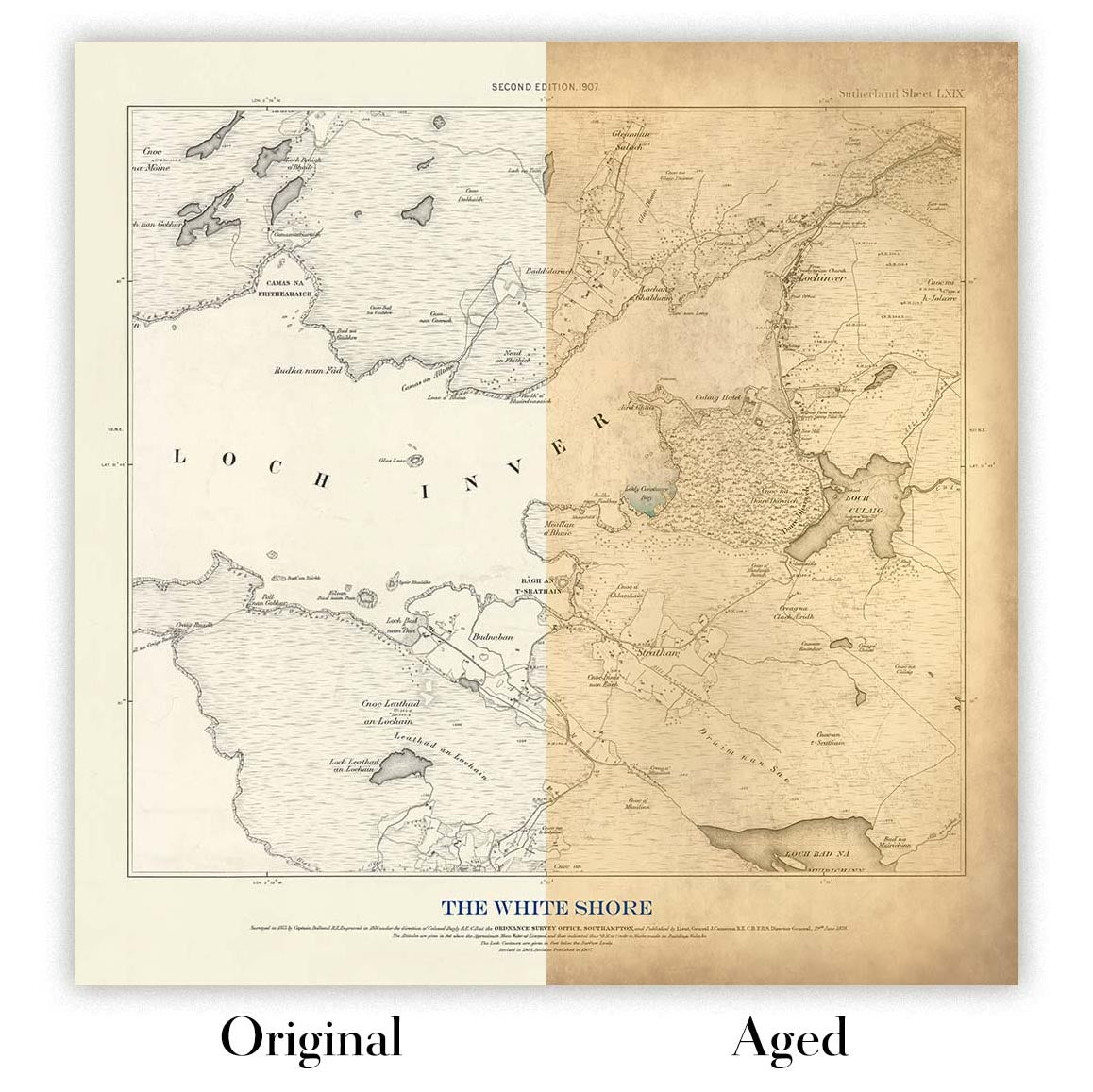
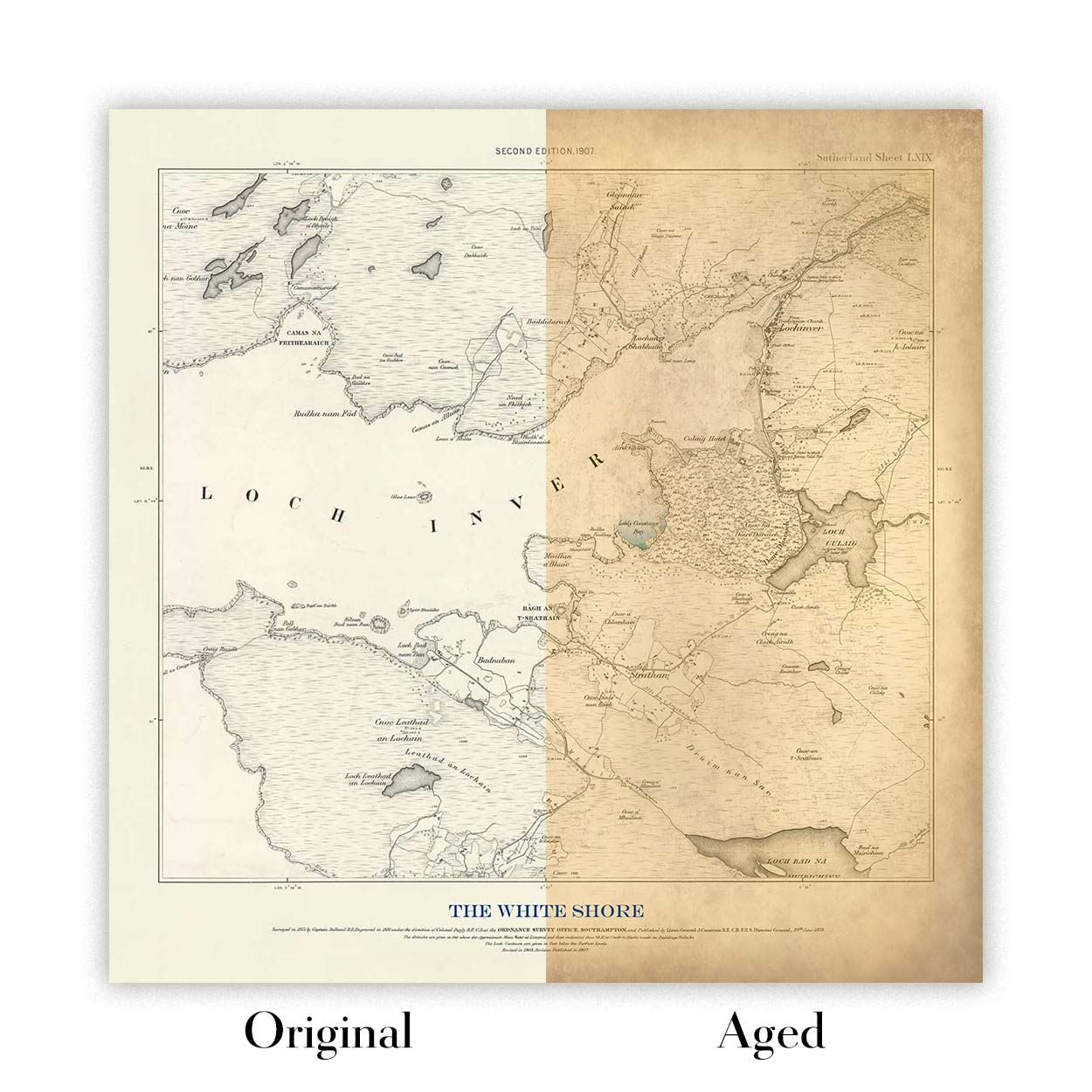
Au fil des ans, des clients m'ont demandé des centaines de fois s'ils pouvaient acheter une carte qui semble uniforme. plus vieux.
Eh bien, vous pouvez désormais le faire en sélectionnant Aged avant d'ajouter une carte à votre panier.
Toutes les photos de produits que vous voyez sur cette page montrent la carte dans sa forme originale. Voilà à quoi ressemble la carte aujourd'hui.
Si vous sélectionnez Vieilli, je vieillirai votre carte à la main, en utilisant un processus spécial et unique développé au cours d'années d'étude de cartes anciennes, de discussions avec des chercheurs pour comprendre la chimie du vieillissement du papier, et bien sûr... beaucoup de pratique !
Si vous n'êtes pas sûr, respectez la couleur originale de la carte. Si vous voulez quelque chose d'un peu plus sombre et plus vieux à la recherche, optez pour Aged.
Nous restaurons et produisons des cartes et des tirages d’art depuis 1984, et nous garantissons chaque pièce.
Chaque commande est couverte par notre garantie de 10 ans et notre garantie de livraison sans dommage. Si votre pièce arrive endommagée, nous la remplacerons ou la referons gratuitement. Si quoi que ce soit d’autre ne vous donne pas entière satisfaction, contactez notre équipe d’atelier et nous y remédierons rapidement.
Consultez notre politique de retours et de remboursement pour plus de détails.
Ou lancez une recherche dans la boutique.


