














Rare Old French World Map of Ocean Basins, 1826: Mémorial topographique et militaire; basin-based hydrography; polar Océan Glacial rings
Restaurado en nuestro taller de Londres a partir del mapa original de 1826 e impreso en calidad museo. Descripción completa
La oferta del coleccionista
Elija dos obras elegibles y obtenga un 20 % de descuento en ambas. Elija tres y la de menor precio será gratuita, con un ahorro máximo del 33 %.
Combine y mezcle mapas estándar elegibles y reproducciones de bellas artes. No se requiere código; la oferta se aplica automáticamente al finalizar la compra.
Se incluyen las configuraciones estándar hechas por encargo. Quedan excluidos los tamaños a medida, los diseños personalizados y los trabajos por encargo.
¿Necesita entrega en diferentes direcciones? Contáctenos antes de realizar el pedido.La oferta del coleccionista
Elija dos obras elegibles y obtenga un 20 % de descuento en ambas. Elija tres y la de menor precio será gratuita, con un ahorro máximo del 33 %.
Combine y mezcle mapas estándar elegibles y reproducciones de bellas artes. No se requiere código; la oferta se aplica automáticamente al finalizar la compra.
Se incluyen las configuraciones estándar hechas por encargo. Quedan excluidos los tamaños a medida, los diseños personalizados y los trabajos por encargo.
¿Necesita entrega en diferentes direcciones? Contáctenos antes de realizar el pedido. Restaurado en Londres • Impreso y enmarcado en la UE

Restaurado a partir del mapa original de 1826 e impreso en calidad museo. Descripción completa
Elige el formato
Elige el acabado


(Más información)
Mensaje de regalo y acabado personalizado

Si deseas agregar un mensaje de regalo, o un acabado (rompecabezas, tablero de aluminio, etc.) que no esté disponible aquí, por favor solicítalo en la "nota del pedido" cuando realices la compra.
Cada pedido es hecho a medida, así que si necesitas que el tamaño se ajuste ligeramente, o que se imprima en un material inusual, háznoslo saber. Hemos realizado miles de pedidos personalizados a lo largo de los años, así que hay (casi) nada que no podamos gestionar.
También puedes contactarnos antes de hacer tu pedido, ¡si lo prefieres!
Llévate a casa un pedazo de historia
Más de 8.000 reseñas de 5 estrellas


Mappe-Monde Pour indiquer la Charpente des deux continents et les principales divisions naturelles de l'Ocean en bassins Oceaniques et en bassins maritimes...
Seguir leyendoMappe-Monde Pour indiquer la Charpente des deux continents et les principales divisions naturelles de l'Ocean en bassins Oceaniques et en bassins maritimes is a striking 1826 vision of the planet conceived through its waters. Issued within the Mémorial topographique et militaire at the behest of France’s ministry of war, it advances a new world picture in which seas are organized as interlocking “bassins” circumscribed by the “charpente” of continental masses. Readable at a glance yet rigorous in scheme, it frames the globe as a system of connected maritime domains—the “Bassin Oriental,” the great oceans, and the polar rings “Océan Glacial Arctique” and “Océan Glacial Antarctique”—inviting the viewer to follow the natural logic of watersheds, straits, and shelves that knit the continents into a single hydrographic whole.
The map’s intellectual genealogy runs through army officer Denaix, whose efforts in geographic education emphasized learning the world structurally—as two vast continents bracing a planetary ocean—and understanding navigation, supply, and strategy through the lens of basin-scale connectivity. Although the cartographer remains anonymous, the sheet is unmistakably part of that program: a didactic world chart that turns from political borders to the physical continuities of marine space. It captures a moment when oceanography was beginning to cohere as a science and when military institutions were crucial patrons, translating cutting-edge knowledge into tools officers could use to plan routes, anticipate currents, and comprehend the global theater.
Its aesthetic discipline amplifies its science. Fine, confident lines articulate coastlines while a measured graticule lays down meridians and parallels with clarity, permitting precise situating of basins and interoceanic gateways. The black-and-white palette, typical of early nineteenth-century cartography, sharpens contrast between landforms and maritime fields, and the French nomenclature is both informative and elegantly spaced. Mountain belts are rendered with restrained hatchures that read as continental spines; rivers wind seaward, visually linking headwaters to the marine basins they feed. Arcs of labeled oceanic space wrap the poles, while the equatorial breadth of the great oceans is handled with a balanced graphic weight, keeping hydrographic hierarchies front and center.
Geographically, the map sweeps across Europe, Africa, Asia, the Americas, and Australia, with the high latitudes framed by the Arctic and Antarctic “glacial” oceans. It privileges physiography over politics, tracing principal ranges and river systems as structural elements that partition and conduct water toward the seas. In doing so, it offers a synoptic reading of how continental relief molds oceanic organization—mountain chains as divides, deltas and estuaries as hinge-points between terrestrial drainage and maritime basins. The result is a world where the great oceans are not empty expanses but articulated regions, patterned by coasts, straits, and the continental skeleton that sustains them.
Historically, this sheet embodies a pivotal turn: cartography as a science of systems, not merely surfaces. Its basin-based worldview anticipates later oceanographic mapping and hydrological thinking, while its military provenance underscores how statecraft and scholarship intertwined in Restoration-era France. The emphasis on natural divisions over national frontiers reflects a disciplined curiosity—an invitation to navigate the planet by structure rather than sovereignty. Today, the map reads as both an elegant artifact of French geographic thought and a prescient blueprint for understanding Earth’s interconnected waters, where artistry serves analysis and every label, from Bassin Oriental to Océan Glacial Arctique, advances a coherent, modern imagination of the sea.
Countries and regions on this map
- Continents: Europe, Africa, Asia, North America, South America, Antarctica, Australia.
- Regions: Arctic regions, Southern Hemisphere territories.
- Bodies of Water: Various oceans including the Atlantic, Indian, and Pacific Oceans as well as specific marine basins.
- Mountain Ranges: Named ranges surrounding the continental areas marked on the map.
Notable Features & Landmarks
- Maritime Basins: Clearly defined basins such as the "Bassin Oriental" and "Oceans" labelled around the world.
- Arctic and Antarctic Regions: Notable delineation of polar regions as "Océan Glacial Arctique" and "Océan Glacial Antarctique."
- Physical Features: Detailed mountain ranges and river systems are marked along landmasses.
- Geographical Annotations: Labels in French providing information about nearby maritime regions and continental structures.
Historical and design context
- Name of the Map: Mappe-Monde Pour indiquer la Charpente des deux continents et les principales divisions naturelles de l'Ocean en bassins Oceaniques et en bassins maritimes.
- Year of Creation: 1826.
- Mapmaker/Publisher: Created by an anonymous cartographer; associated with army officer Denaix.
- Featured in "Mémorial topographique et militaire", produced by order of the military ministry.
- This is a fine general hydrographical world map showcasing the world's maritime basins.
- Part of a geographic system aimed at providing an overview of the world’s hydrography.
- Denaix contributed to geographic education, viewing the world primarily in terms of two large continents, highlighting a developing understanding of hydrography.
- Design and Style: Highly detailed with careful lines depicting mountain ranges and rivers, presented in an elegant black-and-white style characteristic of early 19th-century cartographic works.
- Historical Significance: Reflects a pivotal moment in the science of cartography, coinciding with advancements in oceanographic studies, and illustrates how military interests influenced geographic education.
Please double check the images to make sure that a specific town or place is shown on this map. You can also get in touch and ask us to check the map for you.
This map looks great at every size, but I always recommend going for a larger size if you have space. That way you can easily make out all of the details.
This map looks amazing at sizes all the way up to 70in (180cm). If you are looking for a larger map, please get in touch.
This map is wider than most maps, which would make it a perfect statement piece above a mantelpiece, sofa or desk.
The fifth listing image shows an example of my map personalisation service.
If you’re looking for something slightly different, check out my collection of the best old maps to see if something else catches your eye.
Please contact me to check if a certain location, landmark or feature is shown on this map.
This would make a wonderful birthday, Christmas, Father's Day, work leaving, anniversary or housewarming gift for someone from the areas covered by this map.
This map is available as a giclée print on acid free archival matte paper, or you can buy it framed. The frame is a nice, simple black frame that suits most aesthetics. Please get in touch if you'd like a different frame colour or material. My frames are glazed with super-clear museum-grade acrylic (perspex/acrylite), which is significantly less reflective than glass, safer, and will always arrive in perfect condition.
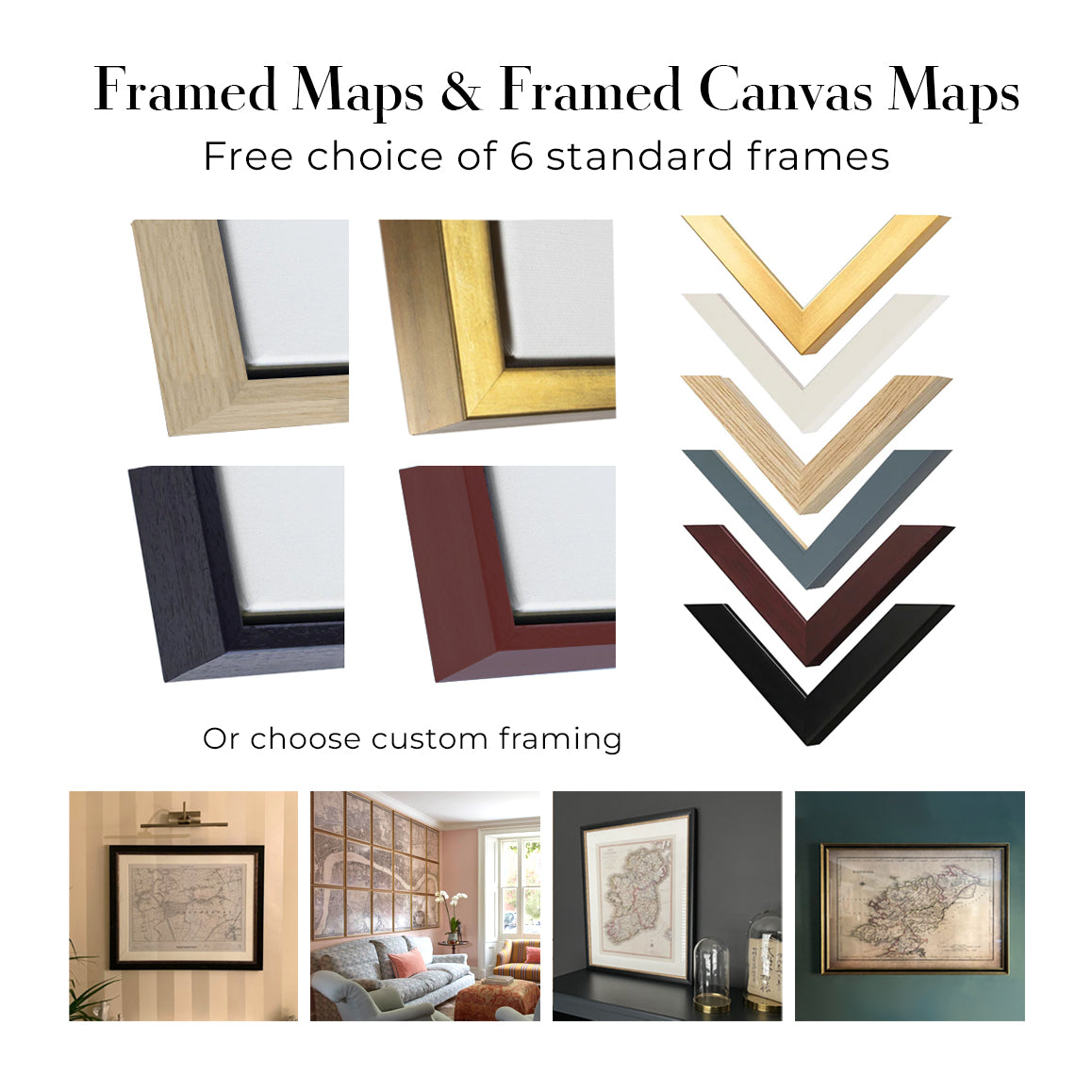
This map is also available as a float framed canvas, sometimes known as a shadow gap framed canvas or canvas floater. The map is printed on artist's cotton canvas and then stretched over a handmade box frame. We then "float" the canvas inside a wooden frame, which is available in a range of colours (black, dark brown, oak, antique gold and white). This is a wonderful way to present a map without glazing in front. See some examples of float framed canvas maps and explore the differences between my different finishes.
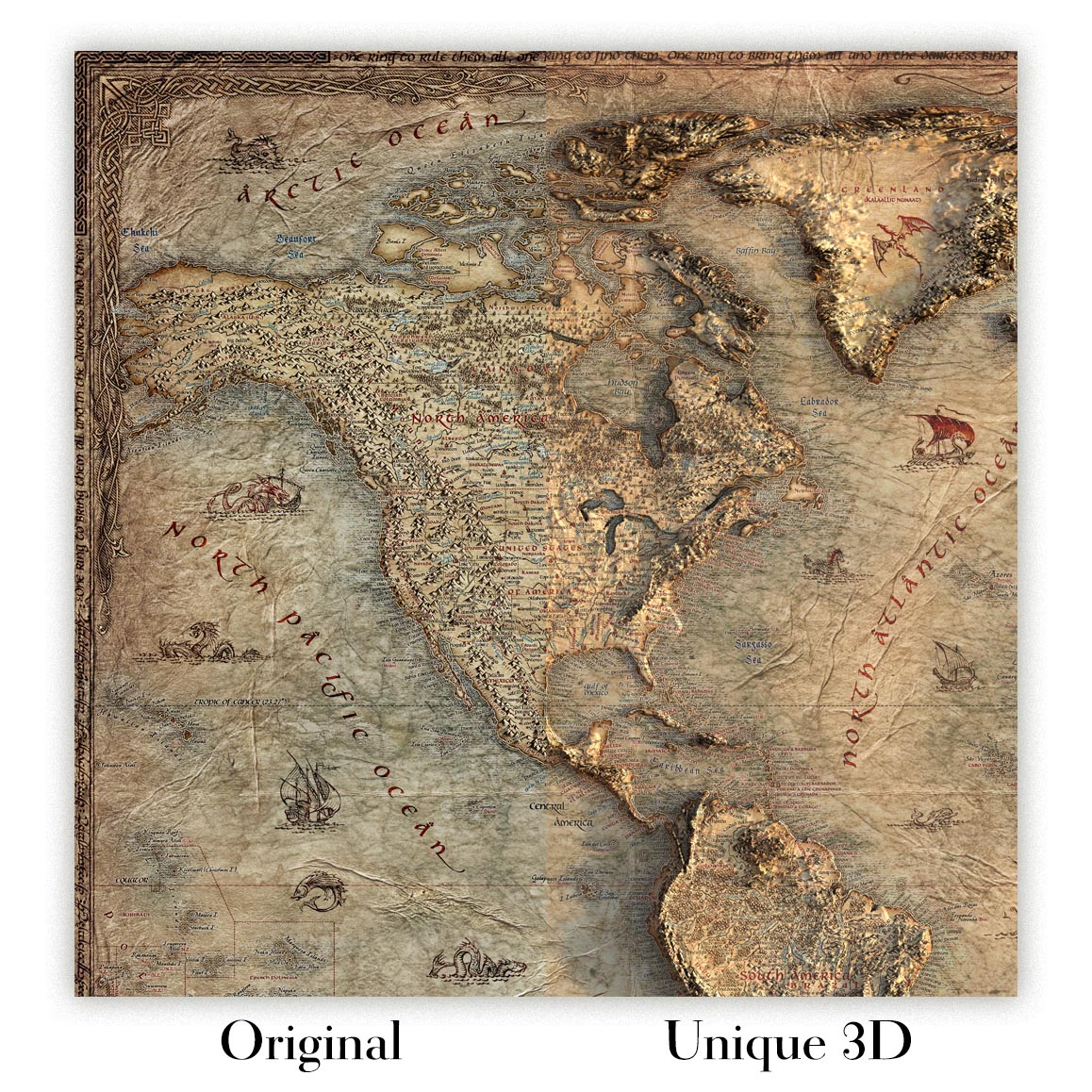
For something truly unique, this map is also available in "Unique 3D", our trademarked process that dramatically transforms the map so that it has a wonderful sense of depth. We combine the original map with detailed topography and elevation data, so that mountains and the terrain really "pop". For more info and examples of 3D maps, check my Unique 3D page.
Mappe-Monde Pour indiquer la Charpente des deux continents et les principales divisions naturelles de l'Ocean en bassins Oceaniques et en bassins maritimes is a striking 1826 vision of the planet conceived through its waters. Issued within the Mémorial topographique et militaire at the behest of France’s ministry of war, it advances a new world picture in which seas are organized as interlocking “bassins” circumscribed by the “charpente” of continental masses. Readable at a glance yet rigorous in scheme, it frames the globe as a system of connected maritime domains—the “Bassin Oriental,” the great oceans, and the polar rings “Océan Glacial Arctique” and “Océan Glacial Antarctique”—inviting the viewer to follow the natural logic of watersheds, straits, and shelves that knit the continents into a single hydrographic whole.
The map’s intellectual genealogy runs through army officer Denaix, whose efforts in geographic education emphasized learning the world structurally—as two vast continents bracing a planetary ocean—and understanding navigation, supply, and strategy through the lens of basin-scale connectivity. Although the cartographer remains anonymous, the sheet is unmistakably part of that program: a didactic world chart that turns from political borders to the physical continuities of marine space. It captures a moment when oceanography was beginning to cohere as a science and when military institutions were crucial patrons, translating cutting-edge knowledge into tools officers could use to plan routes, anticipate currents, and comprehend the global theater.
Its aesthetic discipline amplifies its science. Fine, confident lines articulate coastlines while a measured graticule lays down meridians and parallels with clarity, permitting precise situating of basins and interoceanic gateways. The black-and-white palette, typical of early nineteenth-century cartography, sharpens contrast between landforms and maritime fields, and the French nomenclature is both informative and elegantly spaced. Mountain belts are rendered with restrained hatchures that read as continental spines; rivers wind seaward, visually linking headwaters to the marine basins they feed. Arcs of labeled oceanic space wrap the poles, while the equatorial breadth of the great oceans is handled with a balanced graphic weight, keeping hydrographic hierarchies front and center.
Geographically, the map sweeps across Europe, Africa, Asia, the Americas, and Australia, with the high latitudes framed by the Arctic and Antarctic “glacial” oceans. It privileges physiography over politics, tracing principal ranges and river systems as structural elements that partition and conduct water toward the seas. In doing so, it offers a synoptic reading of how continental relief molds oceanic organization—mountain chains as divides, deltas and estuaries as hinge-points between terrestrial drainage and maritime basins. The result is a world where the great oceans are not empty expanses but articulated regions, patterned by coasts, straits, and the continental skeleton that sustains them.
Historically, this sheet embodies a pivotal turn: cartography as a science of systems, not merely surfaces. Its basin-based worldview anticipates later oceanographic mapping and hydrological thinking, while its military provenance underscores how statecraft and scholarship intertwined in Restoration-era France. The emphasis on natural divisions over national frontiers reflects a disciplined curiosity—an invitation to navigate the planet by structure rather than sovereignty. Today, the map reads as both an elegant artifact of French geographic thought and a prescient blueprint for understanding Earth’s interconnected waters, where artistry serves analysis and every label, from Bassin Oriental to Océan Glacial Arctique, advances a coherent, modern imagination of the sea.
Countries and regions on this map
- Continents: Europe, Africa, Asia, North America, South America, Antarctica, Australia.
- Regions: Arctic regions, Southern Hemisphere territories.
- Bodies of Water: Various oceans including the Atlantic, Indian, and Pacific Oceans as well as specific marine basins.
- Mountain Ranges: Named ranges surrounding the continental areas marked on the map.
Notable Features & Landmarks
- Maritime Basins: Clearly defined basins such as the "Bassin Oriental" and "Oceans" labelled around the world.
- Arctic and Antarctic Regions: Notable delineation of polar regions as "Océan Glacial Arctique" and "Océan Glacial Antarctique."
- Physical Features: Detailed mountain ranges and river systems are marked along landmasses.
- Geographical Annotations: Labels in French providing information about nearby maritime regions and continental structures.
Historical and design context
- Name of the Map: Mappe-Monde Pour indiquer la Charpente des deux continents et les principales divisions naturelles de l'Ocean en bassins Oceaniques et en bassins maritimes.
- Year of Creation: 1826.
- Mapmaker/Publisher: Created by an anonymous cartographer; associated with army officer Denaix.
- Featured in "Mémorial topographique et militaire", produced by order of the military ministry.
- This is a fine general hydrographical world map showcasing the world's maritime basins.
- Part of a geographic system aimed at providing an overview of the world’s hydrography.
- Denaix contributed to geographic education, viewing the world primarily in terms of two large continents, highlighting a developing understanding of hydrography.
- Design and Style: Highly detailed with careful lines depicting mountain ranges and rivers, presented in an elegant black-and-white style characteristic of early 19th-century cartographic works.
- Historical Significance: Reflects a pivotal moment in the science of cartography, coinciding with advancements in oceanographic studies, and illustrates how military interests influenced geographic education.
Please double check the images to make sure that a specific town or place is shown on this map. You can also get in touch and ask us to check the map for you.
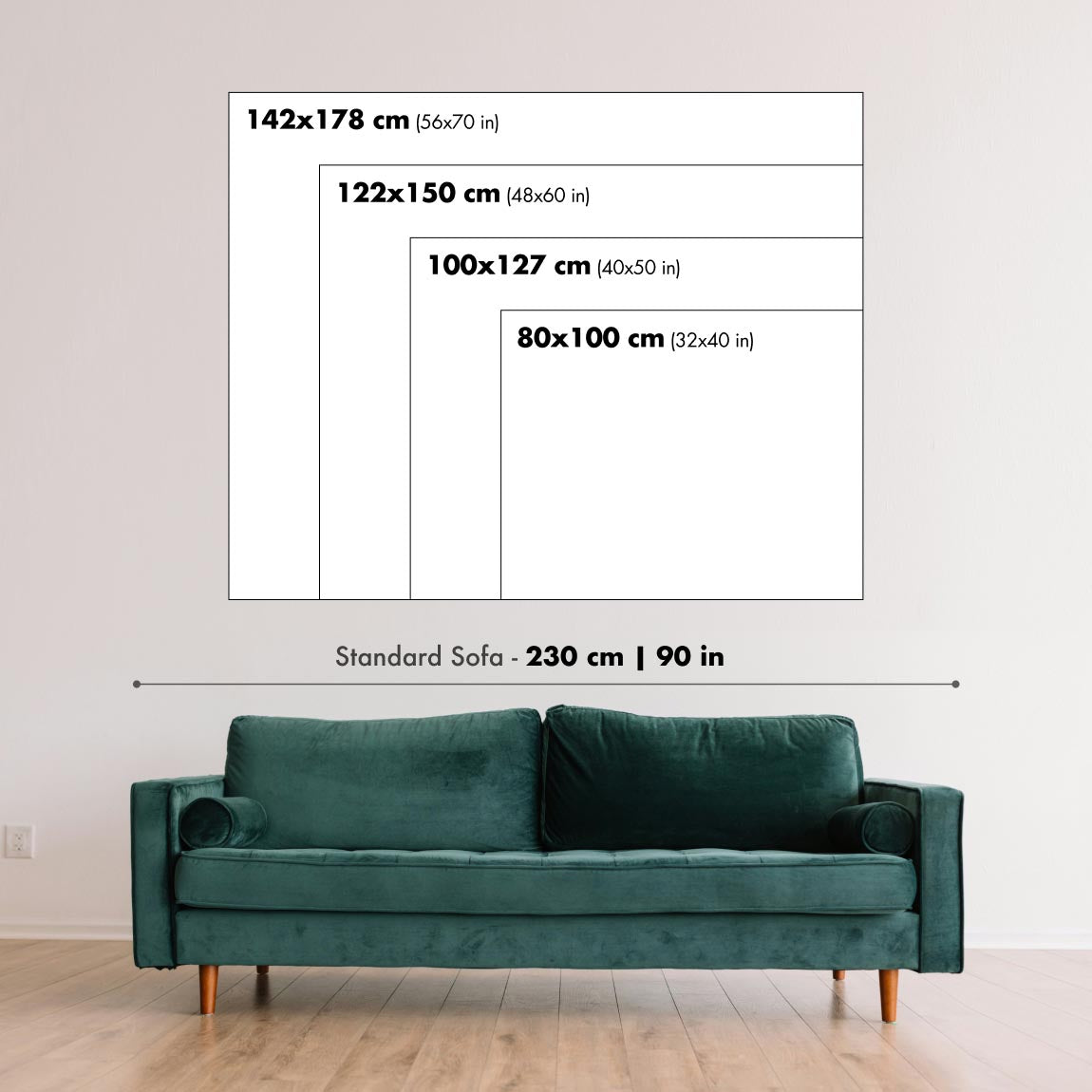
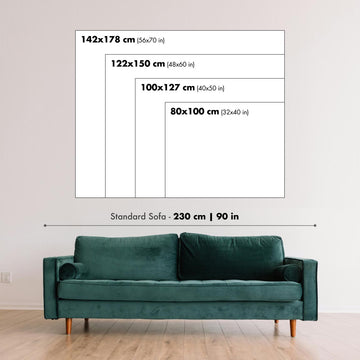
This map looks great at every size, but I always recommend going for a larger size if you have space. That way you can easily make out all of the details.
This map looks amazing at sizes all the way up to 70in (180cm). If you are looking for a larger map, please get in touch.
This map is wider than most maps, which would make it a perfect statement piece above a mantelpiece, sofa or desk.
The fifth listing image shows an example of my map personalisation service.
If you’re looking for something slightly different, check out my collection of the best old maps to see if something else catches your eye.
Please contact me to check if a certain location, landmark or feature is shown on this map.
This would make a wonderful birthday, Christmas, Father's Day, work leaving, anniversary or housewarming gift for someone from the areas covered by this map.
This map is available as a giclée print on acid free archival matte paper, or you can buy it framed. The frame is a nice, simple black frame that suits most aesthetics. Please get in touch if you'd like a different frame colour or material. My frames are glazed with super-clear museum-grade acrylic (perspex/acrylite), which is significantly less reflective than glass, safer, and will always arrive in perfect condition.
This map is also available as a float framed canvas, sometimes known as a shadow gap framed canvas or canvas floater. The map is printed on artist's cotton canvas and then stretched over a handmade box frame. We then "float" the canvas inside a wooden frame, which is available in a range of colours (black, dark brown, oak, antique gold and white). This is a wonderful way to present a map without glazing in front. See some examples of float framed canvas maps and explore the differences between my different finishes.
For something truly unique, this map is also available in "Unique 3D", our trademarked process that dramatically transforms the map so that it has a wonderful sense of depth. We combine the original map with detailed topography and elevation data, so that mountains and the terrain really "pop". For more info and examples of 3D maps, check my Unique 3D page.
Muchos de nuestros mapas y reproducciones de arte se eligen como regalos considerados para hogares, oficinas, despachos y lugares significativos.
Elija una opción enmarcada para el regalo más sencillo, listo para colgar, o elija una lámina sin enmarcar si el destinatario prefiere seleccionar su propio marco.
Producimos los pedidos localmente en 23 países de todo el mundo, por lo que a menudo los regalos pueden realizarse cerca del destinatario. Esto ayuda a que lleguen más rápido, viajen de forma más segura y eviten sorpresas por aduanas o aranceles de importación.
- Podemos entregar directamente al destinatario
- Las piezas enmarcadas llegan listas para colgar
- Las láminas sin enmarcar se embalan cuidadosamente en un resistente tubo protector
- Casi todos los pedidos se producen localmente, para regalar de forma más rápida y segura
- Las devoluciones de 90 días dan al destinatario tiempo para decidir
Si no está seguro de qué elegir, por favor contáctenos. Podemos ayudarle a escoger el mapa, tamaño, acabado u opción de entrega adecuados.
Para la mayoría de los pedidos, el tiempo de entrega es de aproximadamente 3 días laborables. Los productos personalizados y a medida tardan más, ya que tengo que hacer la personalización y enviártelo para su aprobación, lo cual suele tardar 1 o 2 días.
Tenga en cuenta que los pedidos enmarcados muy grandes suelen tardar más en fabricarse y entregarse.
Si necesitas que tu pedido llegue para una fecha determinada, por favor contáctame antes de hacer el pedido para que podamos encontrar la mejor manera de asegurarnos de que recibas tu pedido a tiempo.
Imprimo y enmarco mapas y obras de arte en 23 países alrededor del mundo. Esto significa que tu pedido se fabricará localmente, lo que reduce el tiempo de entrega y asegura que no se dañe durante el envío. Nunca pagarás aranceles de aduana o impuestos de importación, y pondremos menos CO2 en el aire.
Todos mis mapas y impresiones artísticas están bien empaquetados y enviados en un tubo resistente si no están enmarcados, o rodeados de espuma si están enmarcados.
Intento enviar todos los pedidos dentro de 1 o 2 días después de recibir tu pedido, aunque algunos productos (como mascarillas, tazas y bolsas de tela) pueden tardar más en fabricarse.
Si seleccionas Entrega Exprés al finalizar la compra, priorizaremos tu pedido y lo enviaremos por mensajería de 1 día (Fedex, DHL, UPS, Parcelforce).
La entrega al día siguiente también está disponible en algunos países (EE. UU., Reino Unido, Singapur, EAU), pero por favor intenta hacer tu pedido temprano en el día para que podamos enviarlo a tiempo.
Mi marco estándar es un marco de madera de fresno negro estilo galería. Es simple y tiene un aspecto bastante moderno. Mi marco estándar tiene alrededor de 20 mm (0.8 in) de ancho.
Utilizo acrílico super claro (perspex/acrylite) para el vidrio del marco. Es más ligero y seguro que el vidrio, y se ve mejor, ya que la reflectividad es menor.
Seis colores de marco estándar están disponibles de forma gratuita (negro, marrón oscuro, gris oscuro, roble, blanco y oro antiguo).El enmarcado y montaje/matizado personalizado está disponible si buscas algo diferente.
La mayoría de los mapas, arte e ilustraciones también están disponibles como un lienzo enmarcado. Utilizamos lienzo de algodón mate (no brillante), lo estiramos sobre un marco de madera de caja de origen sostenible, y luego 'flotamos' la pieza dentro de un marco de madera. El resultado final es bastante hermoso, y no hay cristal que se interponga.
Todos los marcos se proporcionan "listos para colgar", con una cuerda o soportes en la parte posterior. Los marcos muy grandes tendrán placas de colgar de alta resistencia y/o un listón de montaje. Si tienes alguna pregunta, por favor ponte en contacto.
Mira algunos ejemplos de mis mapas enmarcados y mapas en lienzo enmarcados.
Alternativamente, también puedo proporcionar mapas antiguos y obras de arte en lienzo, tablero de espuma, papel de algodón y otros materiales.
Si deseas enmarcar tu mapa o obra de arte tú mismo, por favor lee mi guía de tamaños primero.
Trabajamos con diseñadores de interiores, negocios de hostelería, profesionales del sector inmobiliario, oficinas y compradores corporativos tanto en piezas individuales como en proyectos coordinados de mayor envergadura.
Este mapa puede adaptarse a una pared, estancia o proyecto concretos, y nuestro taller puede ayudar a coordinar las dimensiones, el material y el enmarcado antes de la producción.
- Dimensiones exactas, de gran formato y a medida
- Enmarcado, montaje y materiales alternativos personalizados
- Piezas coordinadas para varias habitaciones o ubicaciones
- Personalización del mapa para señalar ubicaciones importantes o añadir detalles adicionales
- Asesoramiento sobre el mapa y el enmarcado por parte de nuestro taller
- Producción local para proyectos en todo el mundo
Mis mapas son reproducciones de mapas originales de altísima calidad.
Obtengo mapas originales y raros de bibliotecas, casas de subastas y colecciones privadas de todo el mundo, los restauro en mi taller de Londres y luego uso tintas e impresoras giclée especializadas para crear hermosos mapas que lucen incluso mejor que el original.
Mis mapas están impresos en papel de archivo mate (no brillante) sin ácido que se siente de muy alta calidad y casi como una tarjeta. En términos técnicos, el peso/grosor del papel es de 10 mil/200 g/m². Es perfecto para enmarcar.
Imprimo con tintas pigmentadas Epson ultrachrome giclée UV resistentes a la decoloración, algunas de las mejores tintas que puedes encontrar.
yo también puedo hacer mapas sobre lienzo, trapo de algodón y otros materiales exóticos.
Obtenga más información sobre The Unique Maps Co..
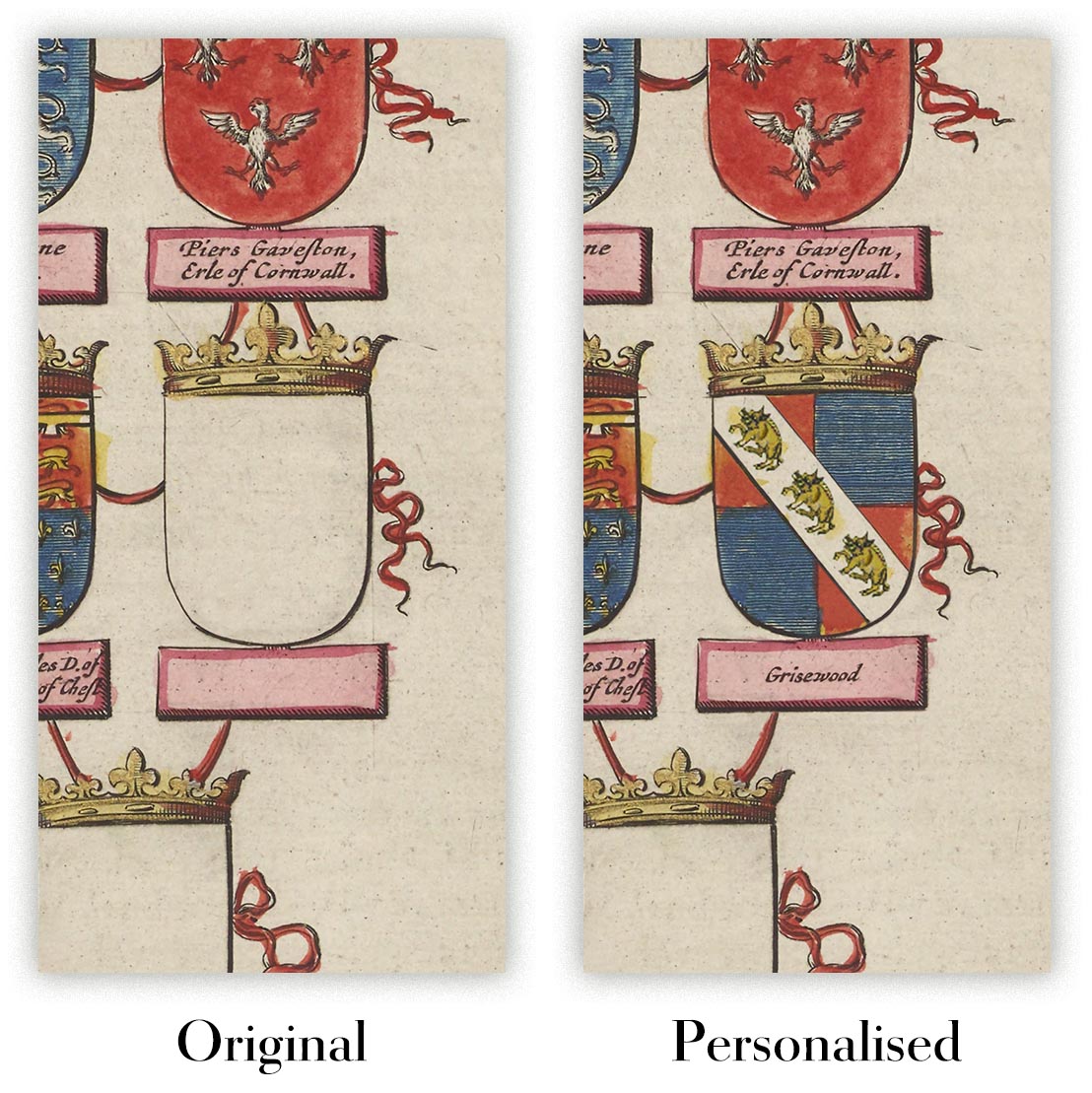
Personalización de mapas
Si está buscando el regalo perfecto de aniversario o inauguración de la casa, puedo personalizar su mapa para hacerlo verdaderamente único. Por ejemplo, puedo agregar un mensaje corto, resaltar una ubicación importante o agregar el escudo de armas de su familia.
Las opciones son casi infinitas. Por favor mira mi página de personalización de mapas para ver algunos maravillosos ejemplos de lo que es posible.
Para pedir un mapa personalizado, seleccione "personalizar su mapa" antes de agregarlo a su carrito.
Ponerse en contacto si buscas personalizaciones y personalizaciones más complejas.
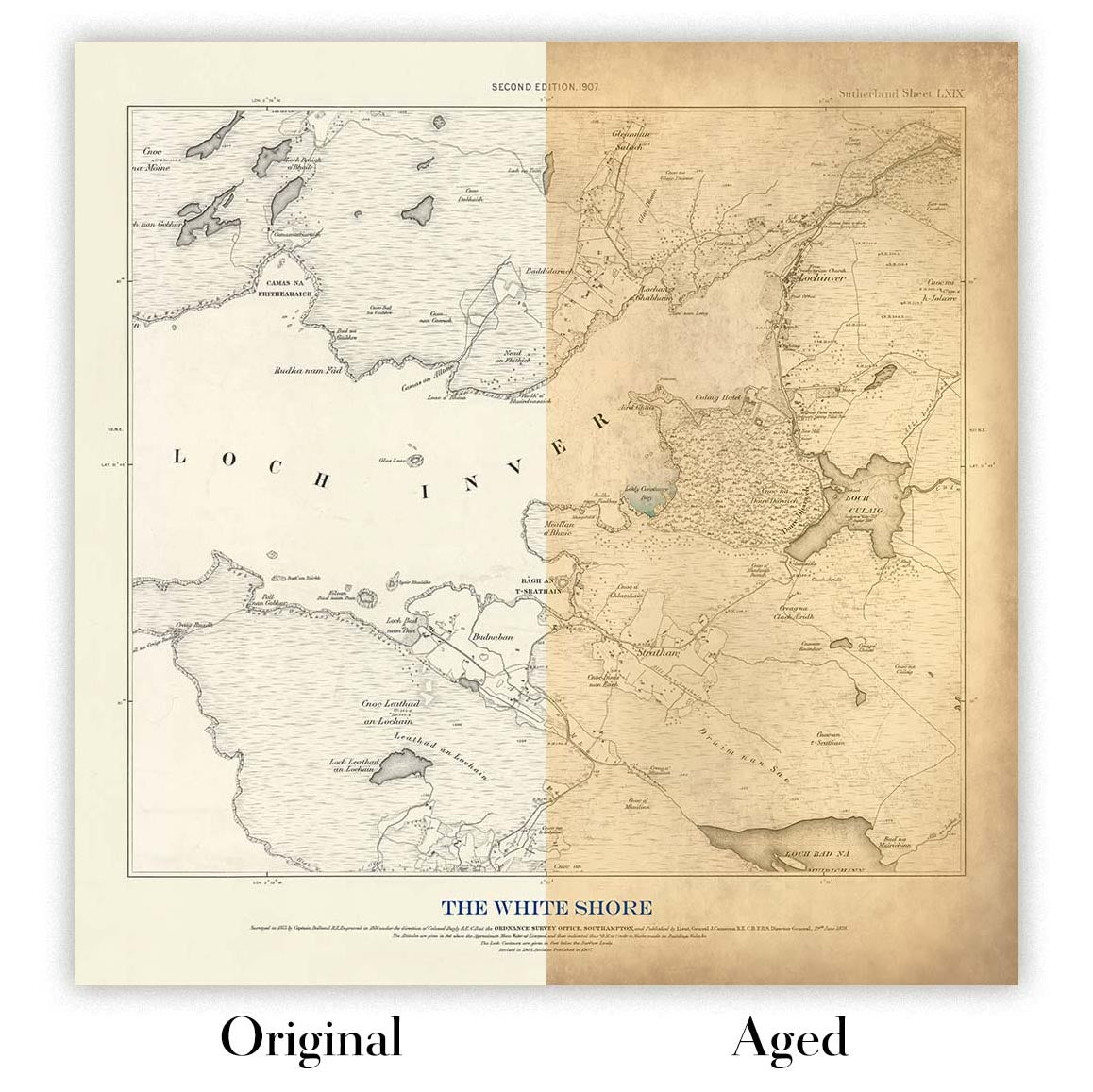
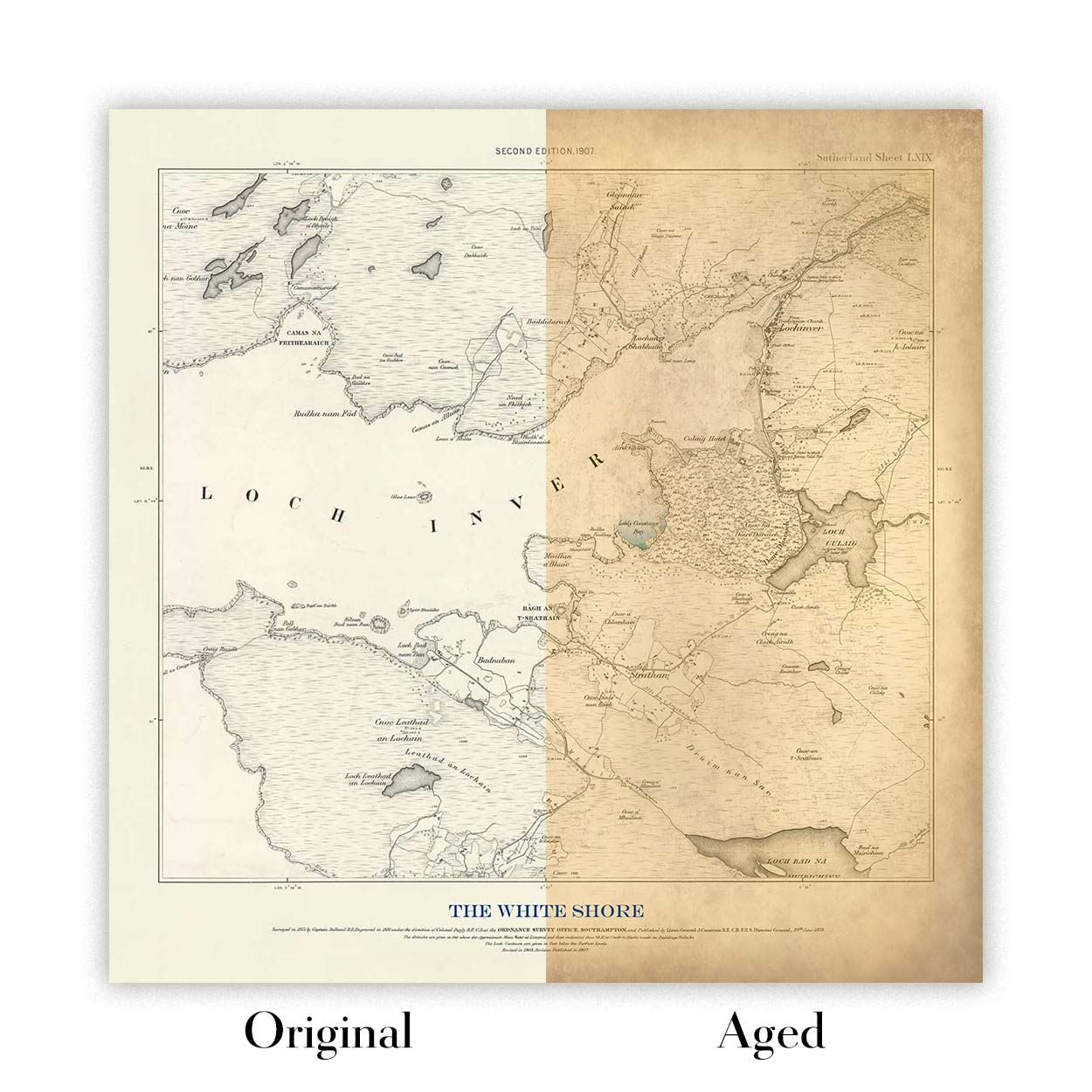
Envejecimiento del mapa
A lo largo de los años, los clientes me han preguntado cientos de veces si podían comprar un mapa que se viera uniforme. más viejo.
Bueno, ahora puedes hacerlo seleccionando Envejecido antes de agregar un mapa a tu carrito.
Todas las fotografías de productos que ve en esta página muestran el mapa en su forma original. Así es como se ve el mapa hoy.
Si selecciona Envejecido, envejeceré su mapa a mano, usando un proceso especial y único desarrollado a través de años de estudiar mapas antiguos, hablar con investigadores para comprender la química del envejecimiento del papel y, por supuesto... ¡mucha práctica!
Si no estás seguro, quédate con el color original del mapa. Si quieres algo un poco más oscuro y más viejo buscando, opte por Envejecido.
Llevamos restaurando y produciendo mapas y láminas artísticas desde 1984, y respondemos por cada pieza.
Todos los pedidos están cubiertos por nuestra garantía de 10 años y nuestra garantía de entrega sin daños. Si su pieza llega dañada, la sustituiremos o la volveremos a producir sin cargo alguno. Si cualquier otro aspecto no es correcto, contacte con nuestro equipo de taller y lo resolveremos con prontitud.
Consulte nuestra política de devoluciones y reembolsos para conocer todos los detalles.


